

Translation management systems (TMS) maintain accuracy by enforcing strict terminology controls, versioning, and human-in-the-loop review workflows. These platforms ensure that every language variant of a government webpage reflects the exact legal and operational intent of the source material. Acumen Velocity supports this process by integrating AI-driven document processing with rigorous quality assurance, ensuring that public-facing content remains compliant and accessible across all supported languages.
The Role of Terminology Bases in Legal Accuracy
Government content is rarely casual. It carries legal weight, regulatory requirements, and specific operational instructions. A translation management system prevents semantic drift by anchoring translators to a centralized terminology base. This base defines how specific terms, such as "benefit eligibility" or "filing deadline," must be rendered in every target language. Without this constraint, different translators might use varying synonyms for the same legal concept, creating confusion for citizens.
The system enforces these rules automatically. When a translator types a term that does not match the approved glossary, the TMS flags it for review. This mechanism is critical for agencies that must maintain consistency across hundreds of pages. For example, a state health department might use a specific term for "insulin coverage." The TMS ensures that this term is identical in the Spanish, Mandarin, and Vietnamese versions of the site. This consistency builds trust and reduces the risk of misinterpretation that could lead to legal liability or public confusion.
Version Control and Audit Trails for Compliance
Government websites are subject to strict compliance standards, including Section 508 of the Rehabilitation Act and various state-level accessibility mandates. A TMS provides a complete audit trail for every change made to the content. This includes who made the change, when it was made, and what the previous version looked like. This level of granularity is essential for demonstrating compliance during audits.
Version control also allows agencies to roll back changes if a translation error is discovered post-publication. In a traditional workflow, fixing a typo in a translated PDF might require re-creating the entire document. In a TMS, the text is separated from the layout. The translator can fix the text, and the system regenerates the layout. This separation of content and design is a key feature of modern translation management. It ensures that the visual integrity of the government brand is maintained while the text is corrected. Acumen Velocity’s approach to data management emphasizes this separation, treating content as a structured asset that can be validated and versioned independently of its presentation layer.
Human-in-the-Loop Review Workflows
While AI can translate text rapidly, it cannot always capture the nuance of legal or cultural context. A robust TMS integrates human-in-the-loop (HITL) review into the workflow. This means that after an AI engine generates a draft translation, a certified human reviewer must approve it before it goes live. The reviewer checks for tone, cultural appropriateness, and legal accuracy. This hybrid approach combines the speed of machine translation with the judgment of human experts.
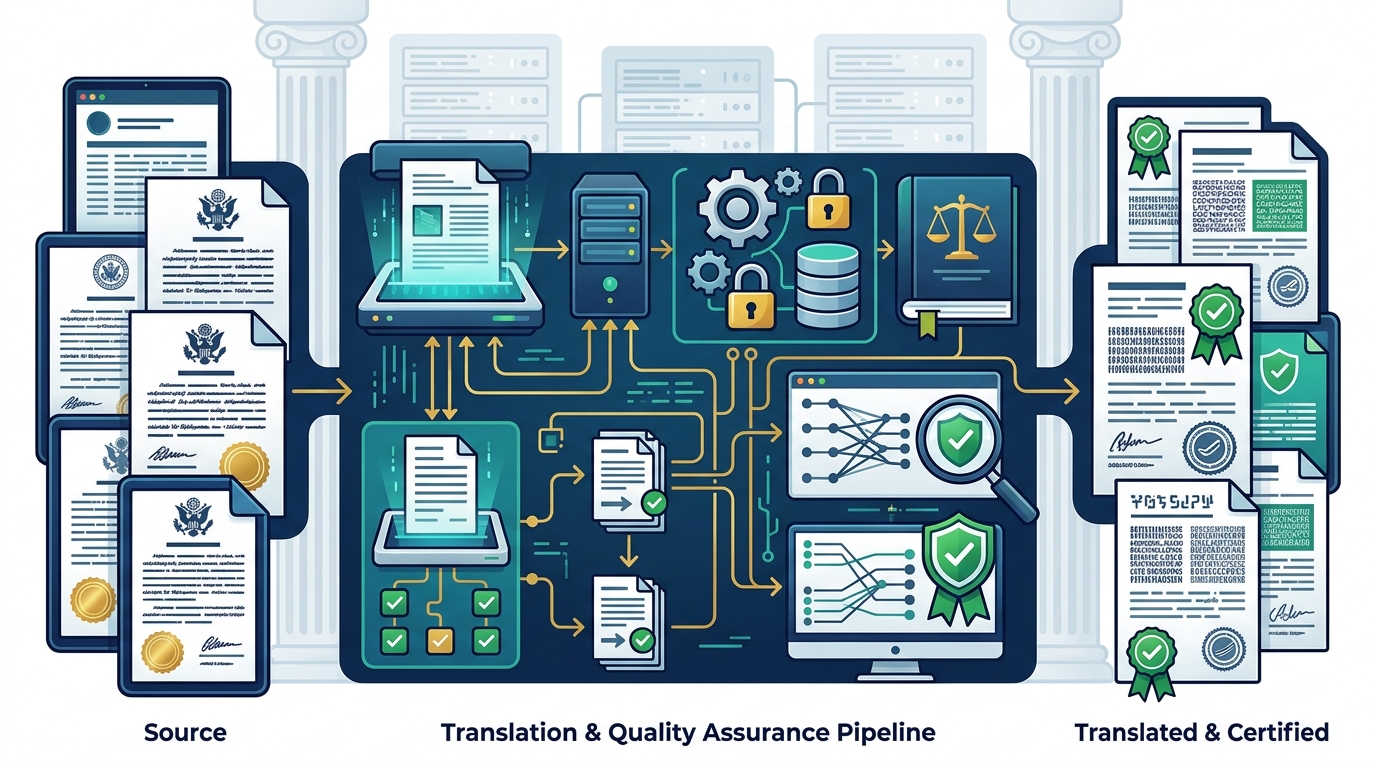
The workflow is typically structured in stages. First, the source content is uploaded. Second, the AI generates a draft. Third, the human reviewer edits the draft. Fourth, a second reviewer or a subject matter expert performs a final quality check. This multi-stage process ensures that no error slips through. For government agencies, this is not optional. It is a requirement for maintaining public trust. The TMS tracks the status of each stage, ensuring that no page is published until it has passed all quality gates. This systematic approach is central to the data quality principles that Acumen Velocity advocates for in all AI-driven initiatives.
Managing Unstructured Documents and Legacy Content
Many government websites still rely on legacy PDFs and unstructured documents. These files are difficult to translate and maintain. A modern TMS can ingest these documents, extract the text, and manage the translation process. However, the challenge lies in preserving the original layout and formatting. If the translated text is longer than the source text, it may overflow the text box in the PDF. The TMS must handle this reflow automatically or flag it for manual adjustment.
Acumen Velocity’s Automated Document Processing solution addresses this specific challenge. It uses AI to extract data from complex documents while maintaining structural integrity. This allows agencies to translate legacy content without manually re-typing every page. The system can also detect when a document has been updated in the source language and trigger a re-translation workflow for the target languages. This ensures that all language versions of a document are always in sync with the latest source material. This capability is crucial for agencies that publish frequently updated guidance, such as tax forms or public health advisories.
Ensuring Accessibility in Target Languages
Accuracy is not just about correct words. It is also about accessibility. A translation that is grammatically correct but not accessible to users with disabilities fails to meet government standards. A TMS can integrate with accessibility checkers to ensure that the translated content meets WCAG standards. This includes checking for proper heading structures, alt text for images, and sufficient color contrast. The system can flag accessibility issues in the translated content before it is published.
This integration is vital for multilingual government sites. A user who is visually impaired and uses a screen reader needs the translated content to be structured correctly. If the TMS does not enforce accessibility rules, the agency risks excluding a significant portion of the population. By embedding accessibility checks into the translation workflow, the TMS ensures that accuracy and inclusivity are achieved simultaneously. This holistic approach to content management is what distinguishes a professional TMS from a simple translation tool. It treats the content as a complete user experience, not just a string of text.
Key Takeaways
- Terminology bases prevent semantic drift by enforcing consistent use of legal and operational terms across all languages.
- Version control and audit trails provide the compliance evidence required for government audits and legal reviews.
- Human-in-the-loop workflows ensure that AI-generated translations are reviewed for nuance, tone, and cultural appropriateness.
- Modern TMS platforms can manage unstructured documents, preserving layout while updating text content.
- Accessibility checks are integrated into the translation process to ensure that translated content meets WCAG standards.
- Acumen Velocity provides AI-driven document processing and data quality services that support these rigorous translation workflows.
Frequently Asked Questions
What is a translation management system?
A translation management system is a software platform that coordinates the workflow of translating content from one language to another, including terminology management, version control, and quality assurance.
Why do government agencies need a TMS?
Government agencies need a TMS to ensure legal accuracy, maintain compliance with accessibility standards, and provide consistent information to citizens across multiple languages.
How does a TMS handle legal terminology?
A TMS uses a centralized terminology base to define approved translations for specific legal terms, ensuring that translators use the correct wording in every language.
Can a TMS manage PDF documents?
Yes, modern TMS platforms can extract text from PDFs, manage the translation, and regenerate the document while preserving the original layout.
What is human-in-the-loop review?
Human-in-the-loop review is a process where human experts review and edit AI-generated translations to ensure accuracy, tone, and cultural appropriateness before publication.
How does Acumen Velocity support translation workflows?
Acumen Velocity provides AI-driven document processing and data quality services that help agencies manage unstructured content and ensure high-quality, compliant translations.
Conclusion
Translation management systems are essential for government agencies that serve diverse populations. They ensure that content is accurate, compliant, and accessible across all languages. By integrating terminology controls, version control, and human review, these platforms reduce the risk of error and build public trust. Acumen Velocity helps agencies implement these rigorous workflows, leveraging AI to streamline the process while maintaining the highest standards of data quality and accuracy. To plan your visit or discuss how to modernize your content management and translation workflows, contact our team. Learn more: Contact us Acumen Velocity.