

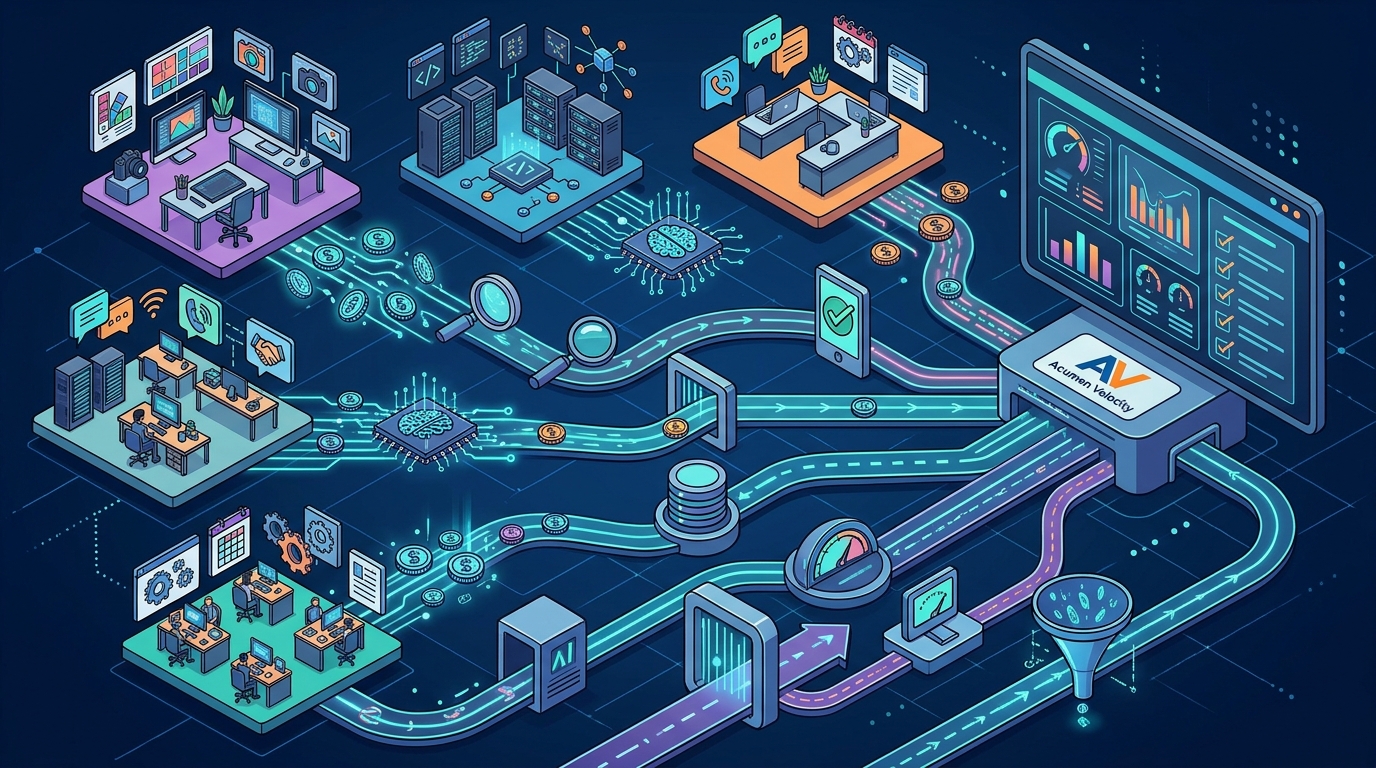
AI spend is becoming a distinct budget line for many organizations, yet visibility into who uses what and what it costs remains fragmented. Teams often subscribe to multiple AI tools independently, leading to duplicate charges and opaque token costs. Acumen Velocity helps enterprises establish centralized visibility and governance so that AI budgets are set based on actual usage data rather than assumptions.
1. Centralize Model Access Through a Single Contract
Consolidate subscriptions to eliminate duplicate billing and fragmented vendor relationships. Most organizations currently pay for several AI subscriptions chosen team by team, which obscures total spend. By routing all requests through a single secure workspace, IT can see usage and cost by department under one contract. This approach ensures that history and context stay with the organization rather than being tied to a single vendor.
2. Implement Automatic Model Routing for Cost Efficiency
Use intelligent routing to send routine tasks to lower-cost models automatically. Simple requests often run on the most expensive top-tier models, inflating budgets unnecessarily. Model routing directs routine work to lower-cost models while reserving premium models for complex tasks. This mechanism allows IT to manage token costs effectively without restricting employee access to the tools they need.
3. Establish Department-Level Chargeback Mechanisms
Assign costs to specific departments to create accountability and transparency. Without clear attribution, AI budgets are often set without the data behind them. Usage reporting by department enables IT to charge back costs to the teams that consume the resources. This practice aligns AI spending with business units and helps finance teams plan more accurately for the coming year.
4. Monitor Usage Patterns to Identify Waste
Analyze real usage data to detect redundant or inefficient workflows. Leaders need to see what each department actually uses AI for to plan the next 12 months effectively. Tracking usage patterns reveals which models and tools are driving value and which are underutilized. This data-driven approach replaces assumptions with evidence, allowing organizations to optimize their AI portfolio continuously.
5. Secure Data Context and History Within the Organization
Retain conversation history and context in a dedicated tenant to maintain control. When AI tools are used via individual vendor accounts, data context often leaves the organization. A secure, dedicated tenant ensures that history and context remain owned by the enterprise. This is critical for compliance and for maintaining a single source of truth for AI interactions across the company.
6. Integrate AI Usage with Existing Data Governance Frameworks
Align AI monitoring with broader data governance and compliance policies. AI spending is not just a financial issue; it is a data governance challenge. Integrating AI usage metrics with existing governance frameworks ensures that data quality and security standards are maintained. This holistic view helps prevent compliance risks associated with unmonitored AI deployments.
7. Start with a Pilot to Validate Cost Models
Run a small-scale pilot to understand actual usage before full-scale rollout. Nobody rolls AI out to a thousand people on day one. A two-month pilot with a small group, such as 10 to 25 people, shows what the organization actually does with AI. This phase allows IT and finance to validate cost models and refine routing rules before committing to enterprise-wide deployment.
Choosing the Right Approach
Select the tracking method that aligns with your current maturity level. Start with centralized access and basic usage reporting, then layer in routing and chargeback as your organization grows. The goal is to move from reactive bill management to proactive budget planning based on real data.
Frequently Asked Questions
Why do AI bills often surprise finance teams?
AI bills surprise finance teams because subscriptions are often purchased independently by individual teams without central oversight. This leads to duplicate charges and a lack of visibility into total token consumption across the organization.
How does model routing reduce AI costs?
Model routing reduces costs by automatically directing simple, routine requests to lower-cost models. It reserves expensive, top-tier models for complex tasks that require higher reasoning capabilities, optimizing the overall spend per request.
What is the benefit of a single contract for AI models?
A single contract simplifies billing and negotiation by consolidating access to multiple AI models under one agreement. It allows organizations to negotiate private rates based on total usage and receive a single invoice instead of multiple vendor bills.
How can IT departments track AI usage by department?
IT departments can track AI usage by implementing a centralized workspace that reports usage and cost by department. This data enables chargeback mechanisms and provides leadership with a clear view of which teams are driving AI adoption and spend.
Is it necessary to pilot AI deployment before full rollout?
Yes, piloting is recommended to validate cost models and usage patterns before a full-scale rollout. A small pilot group helps identify actual workflows and ensures that routing and governance rules are effective before expanding to the entire organization.
How does Acumen Velocity help with AI cost monitoring?
Acumen Velocity provides a secure workspace that gives teams access to major AI models while allowing IT to monitor usage and cost by department. Their solution includes model routing and chargeback features to help organizations manage AI budgets effectively. Learn more: Contact us Acumen Velocity.