

Organizations face a critical balance between security and innovation when managing employee AI usage. Blocking access entirely stifles productivity, while unregulated use creates significant data leakage risks. The solution lies in governed access that provides visibility and control without removing the capability to work. Acumen Velocity helps enterprises navigate this balance by providing frameworks that turn AI from a shadow risk into a managed asset.
1. Unified AI Gateways
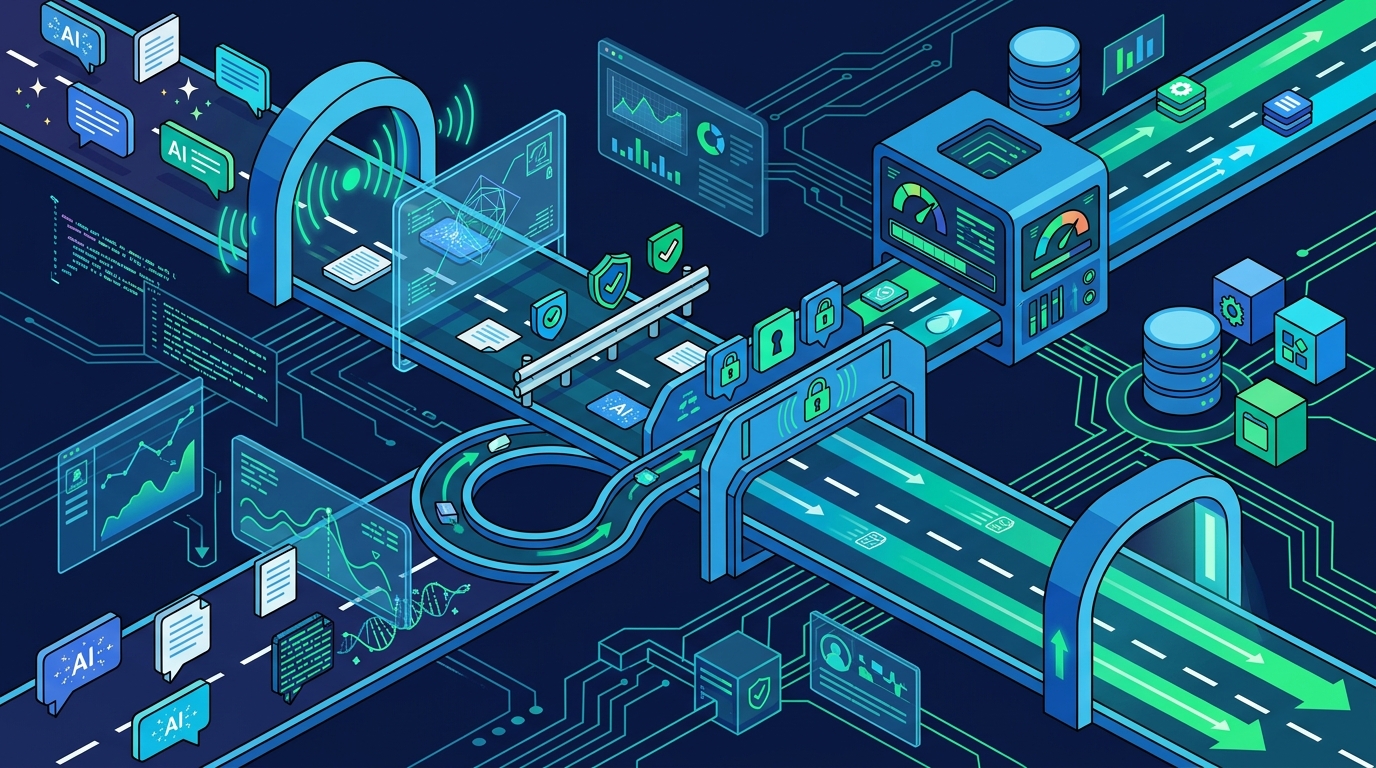
Centralize access through a single, secure entry point for all models. A unified AI gateway is a platform that aggregates multiple AI models behind one interface. This approach allows IT to enforce security policies at the gateway level rather than managing individual subscriptions. Employees retain access to the models they need, but all traffic flows through a controlled channel. This centralization is the foundation of modern shadow AI governance.
2. Model Routing Engines
Automatically direct requests to the most appropriate and cost-effective model. Model routing is a mechanism that analyzes the complexity of a user's prompt and assigns it to a specific AI model. Routine tasks are sent to lower-cost, faster models, while complex reasoning tasks go to advanced models. This ensures that the organization is not paying premium rates for simple queries. It also allows IT to restrict sensitive data from reaching models that lack specific security certifications.
3. Usage Analytics Dashboards
Gain real-time visibility into who is using AI and for what purpose. Usage analytics is a reporting layer that tracks departmental and individual AI consumption. These dashboards reveal patterns in adoption, highlighting which teams are leveraging AI for high-value tasks versus casual experimentation. By understanding actual usage, leaders can make data-driven decisions about budget allocation. This transparency replaces guesswork with evidence-based planning.
4. Departmental Chargeback Systems
Allocate AI costs to specific business units to encourage responsible usage. Chargeback is a financial mechanism that assigns AI usage costs to the departments that generate them. When teams see the direct cost of their AI consumption, they tend to use resources more efficiently. This creates a self-regulating environment where employees are mindful of token usage. It transforms AI from a free, unmonitored utility into a budgeted business expense.
5. Data Context Preservation
Ensure that organizational history and context remain owned by the company. Context preservation is the practice of storing AI interaction history and training data within the organization's own infrastructure. When employees use public AI tools, their work history often becomes the property of the vendor. By keeping this data in-house, the organization retains intellectual property and ensures continuity. This is a critical component of data sovereignty in the AI era.
6. Secure Hosting Tenants
Deploy AI tools in isolated, dedicated environments for each organization. A secure tenant is a dedicated instance of an AI platform that is logically isolated from other users. This ensures that data from one organization never commingles with data from another. It provides the same level of security as traditional enterprise software while offering the flexibility of cloud-based AI. This isolation is essential for industries with strict compliance requirements.
7. Integrated Data Agents
Connect AI models directly to internal data sources for accurate insights. Data agents are interfaces that allow AI models to query internal databases, documents, and APIs. This enables employees to ask questions about their own company data and receive grounded, accurate answers. It reduces the risk of hallucinations by anchoring AI responses in verified internal information. This integration turns AI from a general chatbot into a specialized business assistant.
Choosing the Right Governance Approach
Selecting the right tools depends on your organization's current maturity level and specific risk tolerance. Start with a small pilot group to test the governance framework before a full rollout. Acumen Velocity offers a structured approach to this, beginning with a two-month pilot for 10 to 25 users. This allows you to measure actual usage and costs before committing to a broader deployment. To begin your assessment, explore the AI Workbench to see how governed access can transform your data strategy.
Frequently Asked Questions
Does governing AI use slow down employee productivity?
When implemented correctly, governance actually improves productivity by ensuring employees have access to the right tools for the right tasks. A unified gateway reduces the friction of managing multiple subscriptions. It also provides a consistent experience, so employees do not have to learn different interfaces for different models. The goal is to remove friction, not add bureaucracy.
How do we handle sensitive data in AI prompts?
Secure hosting and data context preservation are key to handling sensitive information. By keeping data within a dedicated tenant, you ensure it does not leave your controlled environment. Additionally, model routing can be configured to block certain types of data from reaching specific models. This layered approach provides robust protection without requiring employees to manually redact every prompt.
Can we use multiple AI models under one contract?
Yes, a unified AI gateway allows you to access multiple models, such as those from OpenAI, Anthropic, and Google, under a single agreement. This simplifies procurement and billing. It also gives you the flexibility to switch models as technology evolves, without having to renegotiate contracts with each vendor. This is a significant advantage over managing individual subscriptions.
What is the first step in implementing AI governance?
The first step is an intake process to understand what each team wants to achieve with AI. This involves mapping current use cases to the appropriate models and tools. It helps identify gaps in the current setup and highlights areas where governance is most needed. A structured pilot is the best way to validate this approach before scaling.
How does Acumen Velocity support AI governance?
Acumen Velocity provides the AI Workbench, a solution that puts major AI models in one secure workspace. It offers IT control over routing, usage, and cost, while giving employees the choice of models they need. The platform is designed to be deployed in a dedicated tenant, ensuring data security and ownership. This approach balances innovation with enterprise-grade control.