

Intelligent document processing (IDP) is an AI-driven technology that extracts, classifies, and structures data from unstructured documents. It transforms manual data entry into automated workflows, significantly reducing processing times and error rates for financial institutions. By leveraging machine learning and natural language processing, IDP enables banks and insurers to handle high volumes of complex paperwork with greater accuracy and speed.
The Definition and Core Mechanics of IDP
Intelligent document processing is a subset of document automation that uses artificial intelligence to understand the context of documents. Unlike traditional OCR, which simply converts images to text, IDP interprets the meaning of that text. It identifies key data points, such as names, dates, and amounts, regardless of the document's layout or format. This capability is crucial for financial services, where documents vary widely in structure and complexity.
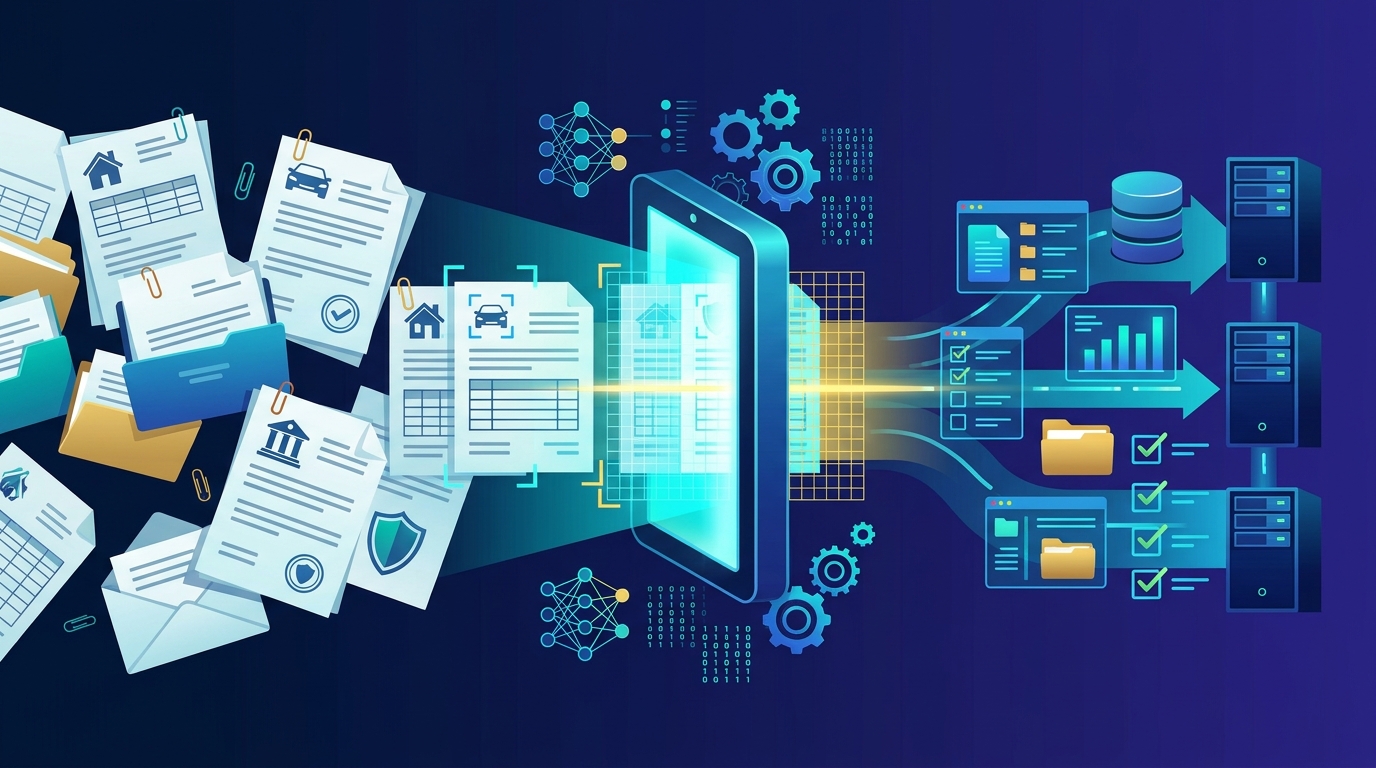
The core mechanics involve three main stages: extraction, classification, and validation. First, the system extracts raw data from PDFs, scans, or emails. Next, it classifies the document type, distinguishing between a loan application and an insurance claim. Finally, it validates the extracted data against business rules to ensure accuracy. This end-to-end approach ensures that data is not only captured but also reliable for downstream systems.
Transforming Banking Workflows
In the banking sector, IDP is revolutionizing onboarding and compliance processes. Banks receive thousands of documents daily, including KYC forms, tax returns, and bank statements. Manual processing of these documents is slow and prone to human error. IDP automates the ingestion of these files, extracting relevant customer data and populating core banking systems in real-time. This reduces the time-to-onboard for new customers from days to hours.
For example, a retail bank can use IDP to process mortgage applications. The system extracts income details, asset information, and credit history from various source documents. It then cross-references this data with internal risk models. This automation allows loan officers to focus on complex decision-making rather than data entry. As a result, banks can improve customer satisfaction and reduce operational costs significantly.
Enhancing Insurance Operations
Insurance companies face unique challenges due to the high volume of claims and policy documents. IDP helps insurers streamline claims processing by automatically extracting details from police reports, medical bills, and photos of damage. This accelerates the claims cycle, allowing insurers to settle valid claims faster. Faster settlements improve customer loyalty and reduce the administrative burden on claims adjusters.
Consider a property insurer handling a flood claim. The IDP system ingests the claim form, the adjuster's report, and supporting invoices. It extracts the total damage amount and categorizes the loss type. The system then flags any discrepancies between the reported damage and the invoice amounts. This level of detail helps prevent fraud and ensures accurate payouts. By automating these steps, insurers can manage large-scale events, such as natural disasters, more effectively.
Integration with Modern Data Platforms
For IDP to deliver maximum value, it must integrate seamlessly with existing data architectures. Financial institutions often rely on legacy systems that are difficult to update. IDP solutions act as a bridge, extracting structured data from unstructured documents and feeding it into modern data lakes or warehouses. This integration ensures that data from documents is available for analytics and reporting.
Acumen Velocity emphasizes the importance of data architecture in supporting AI initiatives. Their Data Architecture & Integration services help organizations design scalable systems that can handle the data flows generated by IDP. By ensuring that extracted data is properly governed and stored, banks and insurers can leverage it for advanced analytics and machine learning models. This holistic approach ensures that document processing is not an isolated task but part of a broader data strategy.
Ensuring Data Quality and Governance
High-quality data is the foundation of successful AI implementations. IDP systems must adhere to strict data governance standards to maintain trust and compliance. In regulated industries like banking and insurance, data accuracy is not just a best practice but a legal requirement. IDP platforms include built-in validation rules and audit trails to ensure that every data point is traceable and accurate.
Acumen Velocity provides Data Governance & Compliance services to help organizations establish robust frameworks for managing AI-generated data. These frameworks ensure that data extracted from documents meets regulatory standards, such as GDPR or HIPAA. By prioritizing data quality, financial institutions can mitigate risks associated with AI adoption and build a reliable foundation for future innovation.
Key Takeaways
- Intelligent document processing uses AI to extract and structure data from unstructured documents, going beyond simple OCR.
- Banks use IDP to automate onboarding, KYC, and loan processing, reducing time-to-onboard and operational costs.
- Insurers leverage IDP to accelerate claims processing and detect fraud by analyzing complex claim documents.
- Effective IDP requires integration with modern data architectures to ensure data is available for analytics.
- Data governance is critical for IDP success, ensuring that extracted data is accurate, compliant, and auditable.
- Acumen Velocity offers specialized services in data architecture and governance to support AI-driven document processing initiatives.
Frequently Asked Questions
How does IDP differ from traditional OCR?
Traditional OCR converts images of text into machine-encoded text but does not understand the context. IDP uses machine learning and natural language processing to interpret the meaning of the text, classify the document, and extract specific data points based on business rules.
What types of documents can IDP process?
IDP can process a wide variety of unstructured documents, including PDFs, scanned images, emails, and handwritten notes. It is particularly effective for complex documents like contracts, invoices, and medical records, where layout and format may vary.
How does IDP improve compliance in financial services?
IDP improves compliance by ensuring that data extraction is consistent and auditable. It can automatically flag discrepancies or missing information, reducing the risk of errors that could lead to regulatory penalties. Additionally, it creates a digital trail of all processing steps, which is useful for audits.
Can IDP handle handwritten documents?
Yes, advanced IDP systems can process handwritten documents using specialized machine learning models trained on handwriting samples. However, accuracy may vary depending on the legibility of the handwriting and the complexity of the content.
What role does data governance play in IDP?
Data governance ensures that the data extracted by IDP is accurate, secure, and compliant with regulations. It defines policies for data access, retention, and usage, which are critical for maintaining trust and meeting legal requirements in financial services.
How can Acumen Velocity help with IDP implementation?
Acumen Velocity provides end-to-end support for IDP implementation, including data strategy, architecture, and governance. Their team helps organizations design scalable data platforms that can integrate IDP solutions and ensure that the extracted data is of high quality and compliant with industry standards.
Conclusion
Intelligent document processing is a transformative technology for banks and insurers, enabling them to automate complex workflows and improve operational efficiency. By integrating IDP with robust data architectures and governance frameworks, financial institutions can unlock the full potential of their document data. Acumen Velocity is committed to helping organizations navigate this transformation, providing the expertise and solutions needed to build AI-ready data platforms. To explore how we can support your document processing and data strategy initiatives, contact our team. Learn more: Contact us.