

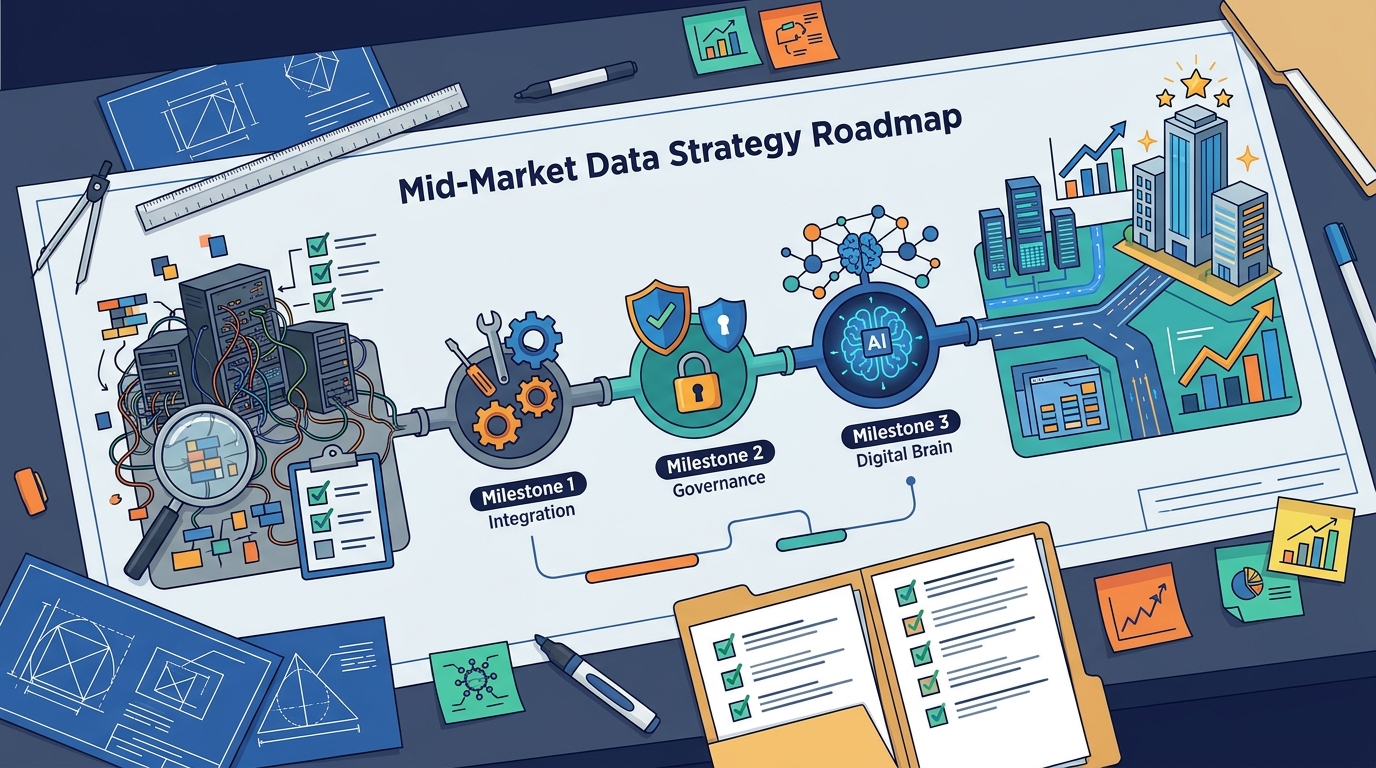
Mid-market companies should prioritize firms that offer a clear, phased roadmap for data maturity, governance, and AI readiness rather than generic technology sales. Before hiring, evaluate a consultant's ability to audit your current data landscape, define specific business outcomes, and provide a transparent framework for implementation. This ensures the engagement drives measurable value instead of creating new technical debt.
The Critical Role of Data Strategy in Mid-Market Growth
Data strategy is the comprehensive plan that aligns an organization's data assets with its business goals. For mid-market enterprises, this alignment is often the difference between reactive operations and proactive innovation. Many companies collect vast amounts of data but lack the structure to turn it into actionable insights. Without a defined strategy, data initiatives often become fragmented projects that fail to scale or deliver consistent returns.
A robust strategy serves as the blueprint for how data is collected, stored, governed, and utilized. It moves beyond simple storage solutions to address the entire data lifecycle. This includes defining who owns the data, how it is protected, and how it powers decision-making across departments. When a mid-market company lacks this blueprint, it risks investing in tools that do not integrate with its existing workflows or business objectives.
Consulting firms play a pivotal role in establishing this foundation. They bring the expertise to assess your current state and design a path forward that is realistic for your budget and team size. The goal is to create a data-centric culture where information flows freely and securely to the people who need it. This cultural shift is often as important as the technical infrastructure itself.
Assessing Your Current Data Maturity
Before engaging a consultant, you must understand where your organization stands in terms of data maturity. Data maturity is the level of sophistication in how an organization manages and utilizes its data. It ranges from ad-hoc, manual processes to fully automated, AI-driven analytics. Most mid-market companies operate in the middle, with some automated systems but significant manual intervention and siloed data sources.
A professional assessment should begin with a discovery phase. This involves auditing your existing data sources, identifying gaps in quality, and mapping the current data lineage. For example, a retail mid-market firm might find that its inventory data is stored in three different systems with conflicting formats. This redundancy creates errors and slows down decision-making. A consultant should be able to identify these issues quickly and propose a unified architecture.
Look for firms that use standardized maturity models to evaluate your organization. These models provide a clear benchmark against which you can measure progress. They help set realistic expectations for the timeline and resources required for transformation. If a consultant promises immediate perfection without a thorough assessment, that is a red flag. The process must be grounded in the reality of your current infrastructure.
Defining Clear Business Outcomes and KPIs
Every data strategy must be tied to specific business outcomes. A data strategy is not just about technology; it is about solving business problems. Before hiring, you should be able to articulate what you want to achieve. Do you want to reduce operational costs, improve customer retention, or accelerate product development? These goals should drive the technical choices made during the consulting engagement.
Key Performance Indicators (KPIs) are the metrics used to track the success of your data initiatives. For instance, if the goal is to improve customer retention, the KPI might be a reduction in churn rate or an increase in customer lifetime value. The consulting firm should help you define these KPIs and build the reporting structures to monitor them. This ensures that the data strategy is not just a technical exercise but a business driver.
Acumen Velocity emphasizes the importance of aligning data strategy with overarching company goals. Their approach involves developing detailed roadmaps for data integration, analytics, and emerging technologies like AI and machine learning. By focusing on business value, they ensure that the data strategy delivers tangible results. This alignment is critical for securing executive buy-in and sustaining the initiative over time.
Evaluating Governance and Compliance Capabilities
Data governance is the system of roles, policies, and procedures that ensure data is managed effectively and securely. For mid-market companies, especially those in regulated industries, governance is not optional. It is a critical component of any data strategy. A consulting firm must demonstrate expertise in establishing governance frameworks that meet regulatory requirements such as GDPR or HIPAA. This includes defining data access controls, privacy policies, and accountability structures.
Compliance is often a major concern for mid-market enterprises. They may not have the dedicated legal or compliance teams that large corporations have. Therefore, the consulting firm must be able to design a governance framework that is both robust and manageable. This involves implementing tools for data quality monitoring, lineage tracking, and audit trails. These tools help ensure that data is accurate, complete, and reliable for decision-making.
Acumen Velocity provides data governance and compliance services that focus on establishing tailored frameworks. They conduct thorough audits to understand the current data landscape and compliance needs. Then, they design and implement a governance framework that aligns with business goals and regulatory standards. This approach ensures that the data strategy is not only effective but also secure and compliant. It reduces the risk of data breaches and regulatory penalties.
Choosing the Right Consulting Partner
Selecting the right consulting partner is a critical decision that can impact your organization for years. You should look for a firm that offers a holistic approach to data strategy. This includes not just technology implementation but also change management and training. The firm should be able to work with your existing teams, providing the skills and knowledge they need to sustain the data strategy after the engagement ends.
Consider the firm's experience with mid-market companies specifically. Large enterprise consultants may have different methodologies and pricing structures that do not fit the needs of a mid-market business. A firm that understands the unique challenges of mid-market enterprises, such as limited budgets and smaller IT teams, will be a better fit. They should be able to offer scalable solutions that grow with your business.
Acumen Velocity is a data-driven team that helps clients leverage data and analytics to drive business value. Their mission is to revolutionize legacy data utilization by transforming and leveraging AI methodologies to enhance data utilization, data quality, and unlock effective decision-making. They prioritize people, process, and performance, ensuring customer delight in every endeavor. This focus on customer success makes them a strong candidate for mid-market companies looking for a long-term partner in their data journey.
Key Takeaways
- Data strategy is the plan that aligns data assets with business goals, moving beyond simple storage to actionable insights.
- Assess your data maturity level before hiring to ensure the consultant's approach matches your current capabilities.
- Define clear business outcomes and KPIs to measure the success of your data initiatives.
- Ensure the consulting firm has expertise in data governance and compliance to meet regulatory requirements.
- Choose a partner that offers holistic support, including change management and training, to sustain the strategy.
- Look for firms with specific experience in mid-market environments to ensure scalable and cost-effective solutions.
Frequently Asked Questions
What is the primary goal of data strategy consulting?
The primary goal is to align an organization's data assets with its business objectives. This involves creating a roadmap for data collection, governance, and utilization that drives measurable business value.
How long does a data strategy engagement typically take?
The duration varies based on the organization's size and complexity. A discovery and assessment phase may take a few weeks, while full implementation can span several months to a year.
Do mid-market companies need a dedicated data team?
Not necessarily. Many mid-market companies start with a small team or augmented staff. The consulting firm can help build the necessary skills and processes within your existing team.
What is data governance?
Data governance is the system of roles, policies, and procedures that ensure data is managed effectively, securely, and in compliance with regulations.
How do I measure the ROI of a data strategy?
ROI is measured by tracking KPIs tied to business outcomes, such as cost reduction, revenue growth, or improved decision-making speed. The consulting firm should help define these metrics upfront.
Can a data strategy include AI and machine learning?
Yes, modern data strategies often include AI and machine learning to enable predictive analytics and automate processes. However, these should be built on a solid foundation of data quality and governance.
Next Steps for Your Data Journey
Starting your data strategy journey requires careful planning and the right partner. By understanding the key components of data strategy, assessing your maturity, and defining clear outcomes, you can make an informed decision when hiring a consulting firm. Focus on firms that offer a holistic approach, combining technical expertise with business alignment. This ensures that your data strategy delivers lasting value and positions your company for future growth.
To begin your data transformation, contact our team to discuss your specific needs and explore how we can help you leverage data and analytics to drive business value.