
Retrieval Augmented Generation (RAG) is a technique that connects large language models to external, up-to-date knowledge bases. It matters because it allows chatbots to answer questions with accurate, verified facts rather than relying solely on static training data. This approach significantly reduces hallucinations and improves user trust in enterprise applications. according to Retrieval Augmented Generation For additional details, review the About Us Acumen Velocity.
Defining Retrieval Augmented Generation
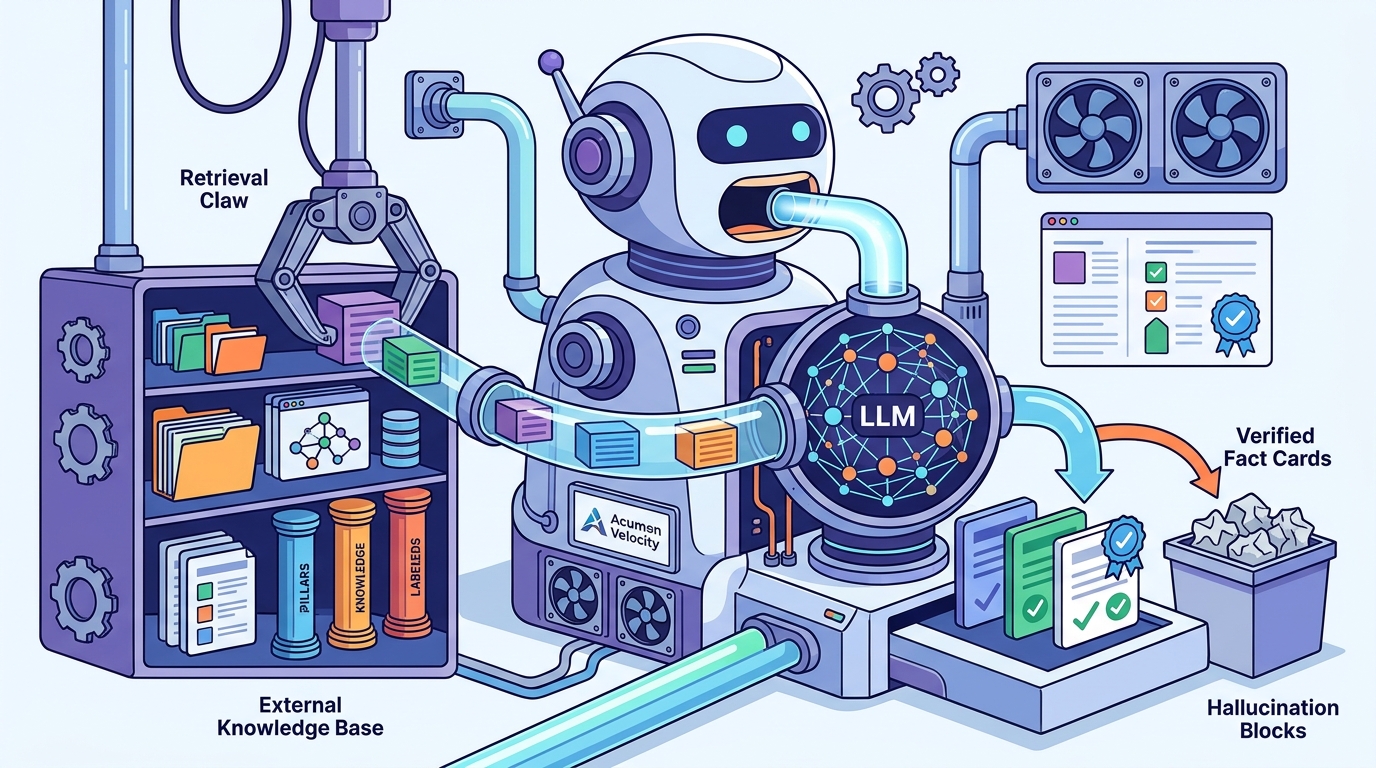
Retrieval Augmented Generation is an AI architecture that combines the generative capabilities of large language models with a retrieval system that fetches relevant documents from a vector database. Traditional large language models are trained on a fixed dataset, which means they cannot know about events or data that occurred after their training cutoff. RAG solves this by allowing the model to search for specific information in real-time before generating a response.
This architecture is critical for organizations that need their AI to reflect current business data. By grounding responses in specific documents, the system provides citations and context that users can verify. This transparency is a major differentiator for enterprise-grade chatbots compared to generic consumer-facing tools.
How RAG Enhances Chatbot Accuracy
The core benefit of RAG is the reduction of hallucinations, which are instances where an AI model generates false or misleading information. When a user asks a question, the RAG system first encodes the query into a vector and searches a knowledge base for the most similar text chunks. These chunks are then injected into the prompt sent to the large language model.
For example, if a customer asks about a specific product feature released last month, a standard model might guess or refuse to answer. A RAG-enabled chatbot retrieves the exact product manual or release notes and uses that text to formulate a precise answer. This mechanism ensures that the chatbot remains accurate even as the underlying business data changes frequently.
Enterprise Data Integration and Governance
Implementing RAG in an enterprise environment requires robust data management and governance. The quality of the retrieval depends entirely on the quality of the data being retrieved. If the source documents are fragmented, outdated, or poorly structured, the chatbot will struggle to provide coherent answers. This is where data strategy and architecture become essential components of the AI stack.
Organizations must ensure that their data is clean, accessible, and properly indexed. This involves establishing data governance frameworks that define who can access what information and how it is maintained. By integrating RAG with a well-governed data platform, businesses can ensure that their chatbots operate within strict compliance and security boundaries.
Building a RAG-Powered Chatbot
Once the data is indexed, the retrieval pipeline is connected to the large language model. The system must be tuned to balance the number of retrieved chunks against the context window of the model. Too few chunks may miss relevant information, while too many can overwhelm the model and increase latency. Continuous monitoring and evaluation are necessary to refine the retrieval process and improve answer quality over time.
The Future of Conversational AI
As AI technology advances, RAG is becoming a standard component of sophisticated chatbot architectures. It enables a shift from static, scripted interactions to dynamic, knowledge-driven conversations. This evolution allows businesses to deploy AI assistants that can handle complex, multi-step queries and provide personalized responses based on real-time data. according to Development and Evaluation
The integration of RAG with other AI techniques, such as fine-tuning and agent-based workflows, will further enhance the capabilities of chatbots. These systems will be able to not only retrieve information but also take actions, such as updating records or triggering workflows, based on the retrieved context. This represents a significant step toward truly autonomous and intelligent digital assistants. according to A Survey on
Key Takeaways
- Retrieval Augmented Generation connects large language models to external knowledge bases for real-time accuracy.
- RAG significantly reduces hallucinations by grounding responses in verified, up-to-date documents.
- Enterprise implementation requires strong data governance and clean, well-structured data sources.
- The quality of the retrieval process depends on effective data chunking and vector embedding strategies.
- RAG enables chatbots to handle dynamic business data without requiring frequent retraining of the model.
- Transparency and citation capabilities in RAG systems build user trust in AI-generated answers.
Frequently Asked Questions
What is the main difference between RAG and fine-tuning?
RAG allows a model to access new information at inference time without changing its weights, while fine-tuning involves retraining the model on specific data to alter its behavior. RAG is generally faster and cheaper to update with new data.
Does RAG eliminate all hallucinations?
No, RAG significantly reduces hallucinations by providing factual context, but it does not eliminate them entirely. The model can still misinterpret the retrieved context or generate text that is not fully supported by the source documents.
What kind of data is best suited for RAG?
Structured and semi-structured documents, such as manuals, FAQs, and knowledge bases, work best. The data should be clean, well-organized, and regularly updated to ensure high-quality retrieval.
How does RAG improve chatbot user experience?
RAG improves user experience by providing accurate, relevant, and up-to-date answers. It also allows for the inclusion of citations, which helps users verify the information and builds trust in the system.
Is RAG only useful for large enterprises?
Conclusion
Retrieval Augmented Generation is a transformative technology that enables smarter, more accurate chatbots. By connecting large language models to real-time knowledge bases, RAG addresses the limitations of static training data and reduces the risk of hallucinations. For organizations looking to deploy AI-driven chatbots, focusing on data quality and governance is essential to unlocking the full potential of RAG. Acumen Velocity helps clients leverage data and analytics to drive business value, ensuring that AI solutions are built on a solid foundation of high-quality data. To explore how RAG can enhance your chatbot strategy, .