
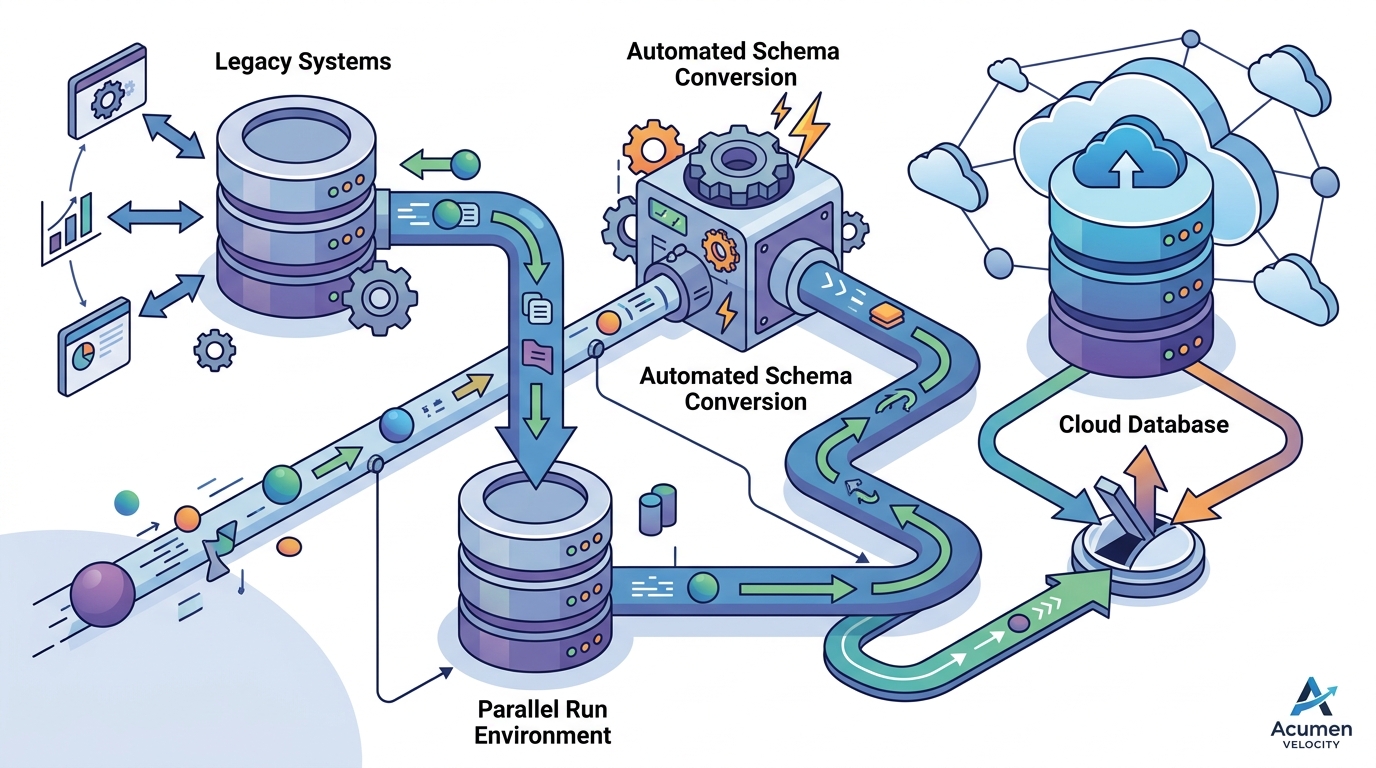
Acumen Velocity achieves zero-downtime cloud database migration by leveraging parallel run environments, automated schema conversion, and continuous data synchronization. This approach ensures that legacy systems remain fully operational while data replicates to the cloud, allowing for a seamless cutover that minimizes business disruption and maintains real-time data integrity. according to Cloud database
The Architecture of Parallel Operations
Traditional database migrations often require taking systems offline, which creates unacceptable risk for operational businesses. A parallel run architecture is a deployment strategy where the legacy on-premises database and the new cloud database operate simultaneously during the migration window. By maintaining both environments, organizations can validate cloud performance without interrupting live user access. This dual-state model is the foundation of a safe transition.
Acumen Velocity utilizes containerized utilities and Docker images to accelerate this process. These tools ensure compatibility between the source and target environments, allowing for rapid validation of data integrity. The implication is that IT teams can shift from a high-risk, big-bang cutover to a controlled, phased transition. This reduces the pressure on support teams and prevents the operational chaos that often accompanies legacy system decommissioning.
Automated Schema Conversion and Integrity
Manual schema conversion is a primary source of migration errors and downtime. Automated schema conversion is a process that uses advanced tools to generate SQL DDL scripts and insert commands that translate legacy structures into cloud-native formats. This automation preserves data integrity by ensuring that relationships, constraints, and data types are accurately mapped. It eliminates the human error that typically causes post-migration failures.
For example, migrating an Oracle database to a cloud-native solution like Postgres requires precise translation of proprietary data types. Acumen Velocity’s migration architecture handles this by assessing the current schema and creating conversion scripts that maintain structural fidelity. The result is a cloud database that behaves exactly like the legacy system, ensuring that applications do not require extensive code rewrites. This technical precision is critical for maintaining business continuity.
Continuous Synchronization and Real-Time Sync
Initial data loads are only the first step in a successful migration. Continuous data synchronization is a mechanism that replicates changes from the source database to the target in near real-time. This ensures that the cloud database is always up to date with the latest transactions occurring in the legacy system. By keeping the two systems in sync, organizations can perform the final cutover with minimal data lag.
During the migration window, data flows through pipelines that handle storage, virtual machine configuration, and post-migration validation. This continuous flow allows for iterative testing and validation. The implication is that when the final switch occurs, the cloud database is already populated with the most current data. This eliminates the need for lengthy batch loads that can take hours or days, significantly reducing the total downtime window.
Strategic Cutover and Validation
The final cutover is the most critical moment in the migration lifecycle. A strategic cutover plan is a detailed roadmap that defines the exact sequence of steps required to redirect traffic from the legacy system to the cloud. This plan includes rollback procedures, validation checkpoints, and communication protocols. By rehearsing this process in a staging environment, teams can identify and resolve potential issues before they impact production.
Acumen Velocity focuses on post-migration validation to guarantee that the cloud environment is stable. This involves monitoring query performance, data accuracy, and application responsiveness. The goal is to ensure that the cloud database not only works but performs better than the legacy system. This validation phase provides the confidence needed to decommission the old infrastructure safely, completing the transition without business disruption.
Key Takeaways
- Parallel run architectures allow legacy and cloud systems to operate simultaneously, eliminating the need for extended downtime.
- Automated schema conversion tools preserve data integrity by accurately translating legacy structures into cloud-native formats.
- Continuous data synchronization ensures that the cloud database remains up to date with real-time transactions during the migration.
- Strategic cutover plans with rehearsed rollback procedures minimize risk and ensure a smooth transition to the new environment.
- Post-migration validation is essential for confirming that the cloud database meets performance and accuracy standards.
- Containerized utilities and Docker images accelerate the migration process by ensuring environment compatibility.
- Acumen Velocity’s end-to-end approach reduces operational costs and increases reliability through optimized cloud database solutions.
Frequently Asked Questions
How long does a zero-downtime database migration take?
The duration depends on the size of the database and the complexity of the schema. However, the actual downtime window is typically measured in minutes rather than hours or days, as the bulk of the work occurs during the parallel run phase.
Do I need to rewrite my application code for the cloud?
Not necessarily. Automated schema conversion and compatibility tools are designed to ensure that the cloud database behaves like the legacy system. This often allows applications to connect to the new database with minimal or no code changes.
What happens if the migration fails during the cutover?
Can I migrate a large database without impacting performance?
Yes, by using continuous synchronization and parallel runs, the legacy system continues to handle production traffic. The cloud system is built in the background, so there is no performance impact on the live business operations during the migration phase.
What is the role of data validation in a cloud migration?
Data validation is the process of comparing data in the legacy and cloud systems to ensure accuracy. It is a critical step in the cutover plan, ensuring that no data is lost or corrupted during the transfer. Acumen Velocity performs rigorous post-migration validation to guarantee data integrity.
Conclusion
Moving your database to the cloud does not have to mean shutting down your business. By leveraging parallel operations, automated conversion, and continuous synchronization, you can achieve a seamless transition that maintains operational continuity. Acumen Velocity provides the expertise and tools necessary to execute this strategy, ensuring that your data is secure, accessible, and ready to drive business value in the cloud. To begin your journey toward a resilient cloud infrastructure, for a consultation.