
Design a data lakehouse structure by organizing data into raw, curated, and consumption layers using open table formats like Apache Iceberg. This approach decouples storage from compute, enabling your analytics team to query data from any engine without vendor lock-in. Acumen Velocity helps enterprises build these scalable, AI-ready foundations on Google Cloud.
Establish a Layered Data Architecture
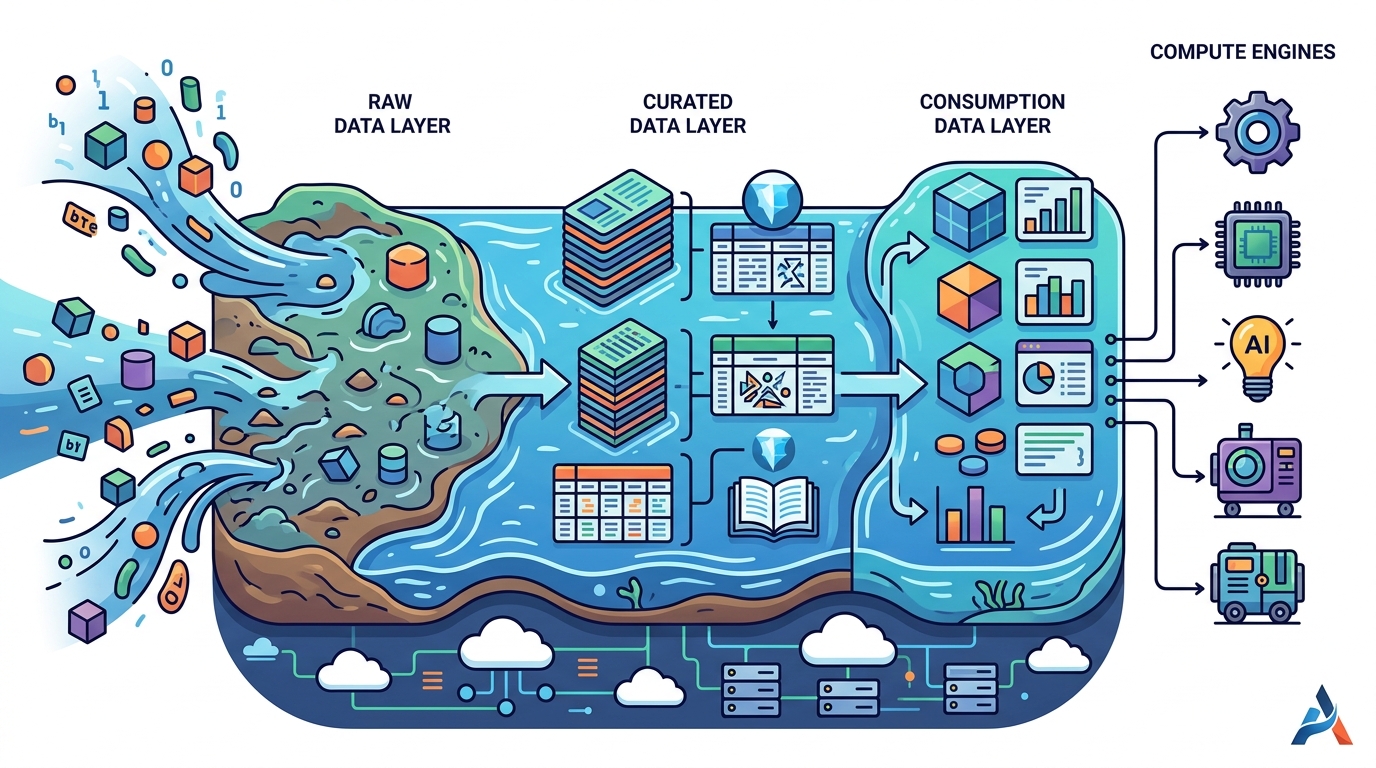
A robust data lakehouse requires a clear separation of data maturity. The raw layer ingests data exactly as it arrives from source systems, preserving the original state for audit and replay. The curated layer applies cleaning, deduplication, and standardization to create a trusted dataset. The consumption layer structures data into marts or views optimized for specific business questions or machine learning models. This layered approach prevents analysts from accidentally corrupting source data while ensuring that downstream consumers receive high-quality inputs.
Acumen Velocity emphasizes that data architecture is not just about storage but about governance. By defining clear boundaries between layers, you reduce technical debt and make it easier to track data lineage. For example, a retail client might store raw transaction logs in the raw layer, clean and join them with customer profiles in the curated layer, and expose a daily sales summary in the consumption layer. This structure allows data engineers to manage complex transformations without impacting the stability of the raw data.
Adopt Open Table Formats for Interoperability
Apache Iceberg is the foundation of modern lakehouses because it decouples storage from compute and supports massive schema evolution. Unlike proprietary formats that lock data into specific engines, Iceberg introduces an open, standardized table layer that can unify structured and unstructured data across clouds and legacy systems. This means your analytics team can query the same data using BigQuery, Spark, Presto, or Dremio without migrating or duplicating it. The ability to write once and read anywhere eliminates the need for brittle ETL pipelines that often slow down time-to-insight.
Metadata is a first-class citizen in Iceberg, tracking schema evolution, partitioning, and versioning automatically. This rich metadata backbone is critical for AI readiness, as it provides the context needed for machine learning models to understand data lineage. Acumen Velocity’s Acumen Vega solution accelerates this adoption by automating the conversion of legacy data into Iceberg format on Google Cloud. This ensures that your data is not only accessible but also versioned and governed from day one.
Optimize for AI and Machine Learning Workloads
A modern data lakehouse must be designed with AI and machine learning in mind from the start. Traditional data warehouses often struggle to handle the scale and diversity of data required for training large language models or predictive analytics. By using a lakehouse, you can store both structured transactional data and unstructured documents, images, or videos in a single environment. This unified access allows data scientists to build features directly from the lakehouse without moving data to separate object storage buckets.
Acumen Velocity integrates native support for Vertex AI, enabling automated snapshot versioning for reproducible ML training runs. This means analysts can track which version of the dataset was used for any prediction, ensuring model transparency and compliance. For instance, a healthcare organization might use Iceberg tables to store patient records and clinical notes, allowing AI models to be trained on a consistent, versioned dataset. This capability transforms the lakehouse from a simple analytics tool into a powerful AI platform.
Implement Robust Data Governance and Security
As data scales, governance becomes a critical component of lakehouse design. You must implement fine-grained access controls, auditing, and lineage tracking to ensure that sensitive data is protected and compliant with regulations. Iceberg supports ACID transactions and time travel, which allow you to roll back changes and audit data modifications. This is essential for industries like finance and healthcare, where data integrity and regulatory compliance are paramount.
Acumen Velocity helps organizations establish tailored data governance frameworks that align with business goals and regulatory standards. By integrating governance into the lakehouse architecture, you ensure that data is secure, compliant, and AI-ready. For example, a banking client might use Iceberg’s access control features to restrict sensitive customer data to specific analysts while allowing broader access to aggregated metrics. This approach balances data accessibility with security, enabling your team to innovate confidently.
Automate Ingestion and Optimization
Manual data management does not scale in a modern lakehouse. You need automated pipelines for ingestion, schema onboarding, and optimization. Acumen Vega automates the hardest parts of lakehouse bootstrapping, including streaming ingestion from Kafka or Pub/Sub and batch migration from Parquet, Delta, or Hive. It also includes a built-in profiler and converter for schema onboarding, allowing data engineers to quickly onboard legacy and streaming datasets into fully optimized Iceberg tables.
Autonomous optimization is another key feature, where the platform tunes storage and query performance automatically. This reduces the operational burden on your data engineering team, allowing them to focus on high-value tasks like building analytics models. By automating these processes, you ensure that your lakehouse remains efficient and cost-effective as data volumes grow. Acumen Velocity’s approach to automation ensures that your data infrastructure can keep pace with your business’s evolving needs.
Key Takeaways
- Use a layered architecture with raw, curated, and consumption layers to manage data maturity and governance.
- Adopt open table formats like Apache Iceberg to enable interoperability and avoid vendor lock-in.
- Design the lakehouse for AI workloads by integrating native ML tools and versioning capabilities.
- Implement robust governance with fine-grained access controls and lineage tracking to ensure compliance.
- Automate ingestion and optimization to reduce operational overhead and scale efficiently.
- Leverage solutions like Acumen Vega to accelerate Iceberg adoption on Google Cloud.
Frequently Asked Questions
What is a data lakehouse?
A data lakehouse is an integrated data architecture that combines the flexibility of a data lake with the governance and performance of a data warehouse. It uses open table formats to store data in a unified environment, enabling both analytics and AI workloads.
Why is Apache Iceberg important for lakehouses?
Apache Iceberg is important because it provides an open, standardized table format that decouples storage from compute. It supports schema evolution, ACID transactions, and interoperability across different query engines, making it ideal for modern data platforms.
How does a lakehouse support AI and machine learning?
A lakehouse supports AI by providing a unified environment for both structured and unstructured data. It enables versioning, lineage tracking, and direct integration with ML platforms, allowing data scientists to build and train models on consistent, high-quality data.
What are the benefits of using open table formats?
Open table formats like Iceberg eliminate vendor lock-in, allowing you to query data from any engine. They also support metadata management, versioning, and schema evolution, which are critical for data governance and AI readiness.
How can Acumen Velocity help with lakehouse design?
Acumen Velocity helps design and implement scalable data lakehouses on Google Cloud using Acumen Vega. This solution automates Iceberg adoption, integrates with Vertex AI, and ensures robust governance, enabling your team to build AI-ready data platforms.
What is the role of data governance in a lakehouse?
Data governance in a lakehouse ensures that data is secure, compliant, and trustworthy. It involves implementing access controls, auditing, and lineage tracking to manage data quality and regulatory compliance across the entire data lifecycle.
How do you automate data ingestion in a lakehouse?
You can automate data ingestion using tools that support streaming and batch processing. Acumen Vega, for example, automates ingestion from sources like Kafka and Pub/Sub, as well as batch migration from legacy formats, ensuring that data is loaded into optimized Iceberg tables efficiently.
Conclusion
Designing a data lakehouse structure requires a strategic approach that balances flexibility, governance, and AI readiness. By adopting open table formats like Apache Iceberg and implementing a layered architecture, you can build a scalable platform that supports your analytics and machine learning goals. Acumen Velocity provides the expertise and tools to help you navigate this journey, ensuring that your data infrastructure is robust, compliant, and ready for the future. To start building your AI-ready data platform, for a consultation.