

How to Verify Cloud Platform Performance for Analytics Workloads
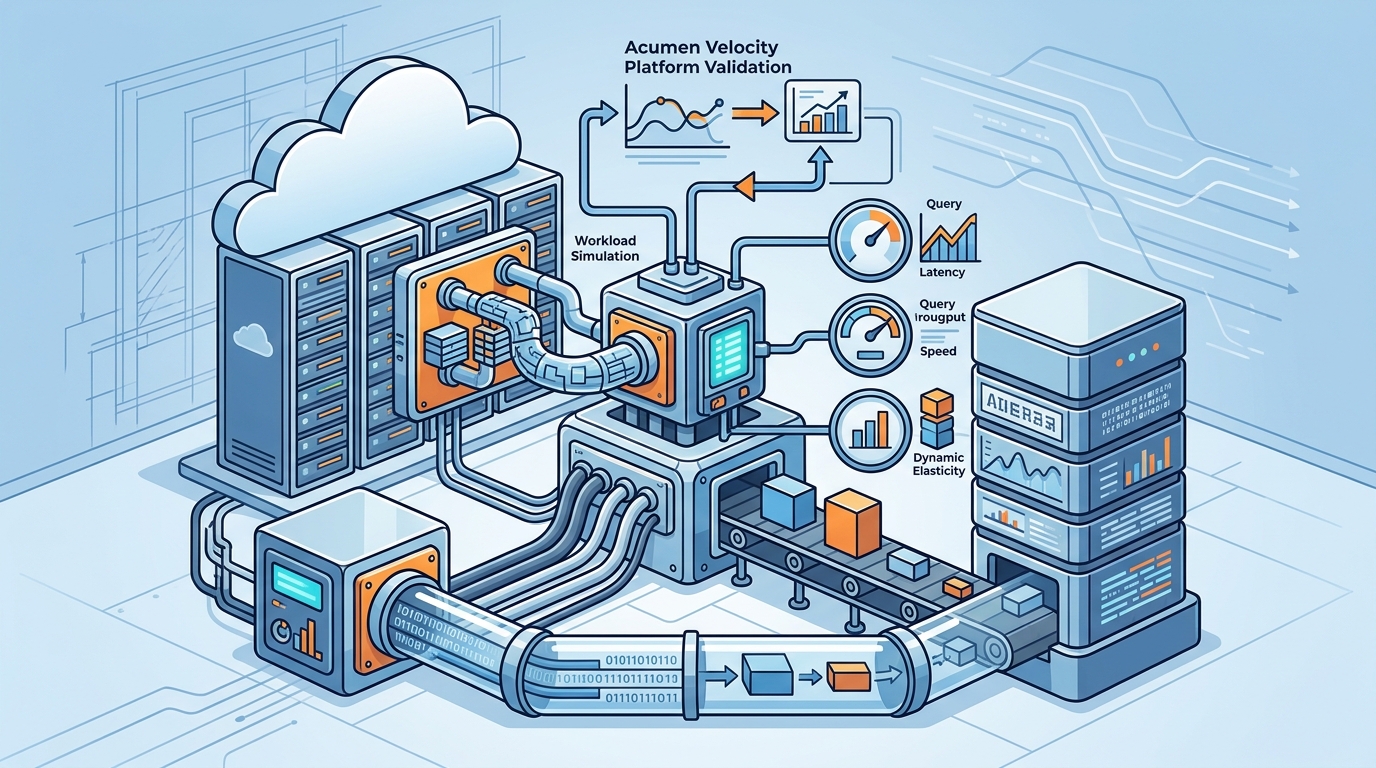
Cloud platform performance for analytics depends on matching specific workload requirements to verified infrastructure capabilities. Organizations must benchmark query latency, data throughput, and resource elasticity against their actual data volumes. Acumen Velocity helps enterprises validate these metrics to ensure their chosen platform delivers reliable, scalable analytics performance.
Defining Performance Metrics for Analytics
Analytics performance is the measure of how quickly and accurately a system processes data queries and generates insights. It is not a single metric but a combination of latency, throughput, and consistency. Understanding these components is the first step in evaluating any cloud provider.
Query latency is the time taken from submitting a request to receiving the first result. Throughput is the volume of data processed per unit of time. Consistency is the reliability of performance under varying loads. Each of these metrics impacts user experience and business decision-making speed differently.
Many organizations focus only on raw compute power, ignoring the overhead of data movement and storage access. This leads to underestimating the true performance cost of a platform. A comprehensive evaluation must account for the entire data path, from ingestion to visualization.
Benchmarking Against Real-World Workloads
Theoretical benchmarks often fail to predict real-world performance because they do not account for data complexity and concurrent user behavior. A platform that excels in synthetic tests may struggle with messy, unstructured data or peak-hour traffic. You must test with your own data patterns and query types.
Consider a retail analytics workload that processes millions of transaction records daily. A platform might show fast query times on a clean, indexed dataset but degrade significantly when handling unstructured customer feedback logs. This discrepancy highlights the need for workload-specific testing. Acumen Velocity recommends conducting proof-of-concept tests with representative data subsets to uncover these hidden performance bottlenecks.
Another critical factor is data locality. Moving data across regions or between storage tiers adds latency that is often not reflected in standard benchmarks. Evaluate the network topology and data residency requirements of your platform. This ensures that your analytics queries do not suffer from unnecessary data transfer delays.
Evaluating Scalability and Elasticity
Scalability is the ability of a system to handle increased workloads by adding resources. Elasticity is the ability to automatically scale resources up or down based on demand. For analytics workloads, elasticity is crucial for managing cost and performance during peak periods. A platform that cannot scale quickly enough will cause query timeouts and user frustration. according to Reliability statistics
Test how your platform handles sudden spikes in query volume. For example, a financial services firm might experience a 500% increase in analytics queries during quarterly reporting periods. The platform must provision additional compute resources within seconds, not minutes. Verify the provider's auto-scaling policies and minimum provisioning times. This ensures that your team is not waiting for resources to become available.
Assessing Data Integration and Ecosystem Fit
Performance is not just about the compute engine; it is also about how efficiently data moves into and out of the platform. Data integration is the process of combining data from multiple sources into a unified system. Poor integration can become a major performance bottleneck, slowing down the entire analytics pipeline.
Evaluate the native connectors and APIs available for your data sources. If your platform requires complex, custom ETL scripts to ingest data from legacy systems, you may face significant latency and maintenance overhead. Look for platforms with robust, pre-built connectors for your specific technology stack. This reduces the time and effort required to set up and maintain data pipelines.
Furthermore, consider the ecosystem of tools that integrate with the platform. A strong ecosystem includes BI tools, data visualization software, and machine learning frameworks. Seamless integration with these tools ensures that your data scientists and analysts can work efficiently without dealing with compatibility issues. Acumen Velocity helps organizations map their existing tech stack to the cloud platform's ecosystem to ensure a smooth transition.
Ensuring Reliability and Uptime
Reliability is the ability of a system to perform its intended function consistently over time. For analytics workloads, downtime can have significant business impacts, especially if the data is used for real-time decision-making. Evaluate the provider's service level agreements (SLAs) and historical uptime records. An SLA of 99.9% allows for up to 8.76 hours of downtime per year, which may be unacceptable for critical applications.
Investigate the platform's disaster recovery and failover capabilities. A reliable platform should have automated failover mechanisms that switch to backup resources in the event of a failure. Test these mechanisms during your proof-of-concept phase to ensure they work as expected. Acumen Velocity emphasizes the importance of testing failover scenarios to validate the platform's resilience.
Additionally, consider the provider's support and monitoring tools. Real-time monitoring and alerting are essential for identifying and resolving performance issues before they impact users. Look for platforms that offer comprehensive dashboards and logging capabilities. This allows your team to proactively manage performance and maintain high availability.
Key Takeaways
- Define specific performance metrics such as latency, throughput, and consistency for your analytics workloads.
- Benchmark platforms using real-world data and query patterns, not just synthetic tests.
- Evaluate scalability and elasticity to ensure the platform can handle peak loads without degradation.
- Assess data integration capabilities and ecosystem fit to minimize pipeline bottlenecks.
- Verify reliability through SLAs, uptime records, and failover testing.
- Conduct proof-of-concept tests with representative data to uncover hidden performance issues.
- Align scaling models with usage patterns to optimize cost and performance.
Frequently Asked Questions
What is the most important performance metric for analytics workloads?
Query latency is often the most critical metric, as it directly impacts user experience and decision-making speed. However, throughput and consistency are also essential for handling large volumes of data and ensuring reliable performance.
How can I test a cloud platform's performance before committing?
Conduct a proof-of-concept test using a representative subset of your data. Run your typical queries and measure latency, throughput, and consistency. This will give you a realistic view of the platform's performance under your specific workload conditions.
Does data locality affect analytics performance?
Yes, data locality significantly impacts performance. Moving data across regions or between storage tiers adds latency. Choose a platform that allows you to store and process data in the same region to minimize transfer delays.
How important is the ecosystem of tools when choosing a cloud platform?
The ecosystem is crucial for performance and efficiency. A strong ecosystem with pre-built connectors and integrations reduces the time and effort required to set up and maintain data pipelines, leading to faster and more reliable analytics.
What should I look for in a provider's SLA?
Look for an SLA that guarantees high uptime, such as 99.9% or higher. Also, review the terms for downtime credits and the provider's historical uptime records to assess their reliability.
How does Acumen Velocity help with cloud platform evaluation?
Acumen Velocity helps organizations validate cloud platform performance by conducting proof-of-concept tests, benchmarking against real-world workloads, and assessing scalability and reliability. We ensure that the chosen platform meets your specific analytics requirements.
Next Steps for Your Analytics Strategy
Choosing the right cloud platform for analytics requires a thorough evaluation of performance, scalability, and reliability. By defining your specific metrics and testing with real-world data, you can make an informed decision that supports your business goals. Acumen Velocity provides expert guidance to help you navigate this process and ensure your analytics workloads run efficiently on the cloud.
Ready to optimize your analytics performance? Contact Acumen Velocity to discuss your cloud platform evaluation needs and build a data strategy that delivers reliable, scalable insights.