

What to Expect From a Cloud Migration Partner in Healthcare and Financial Services
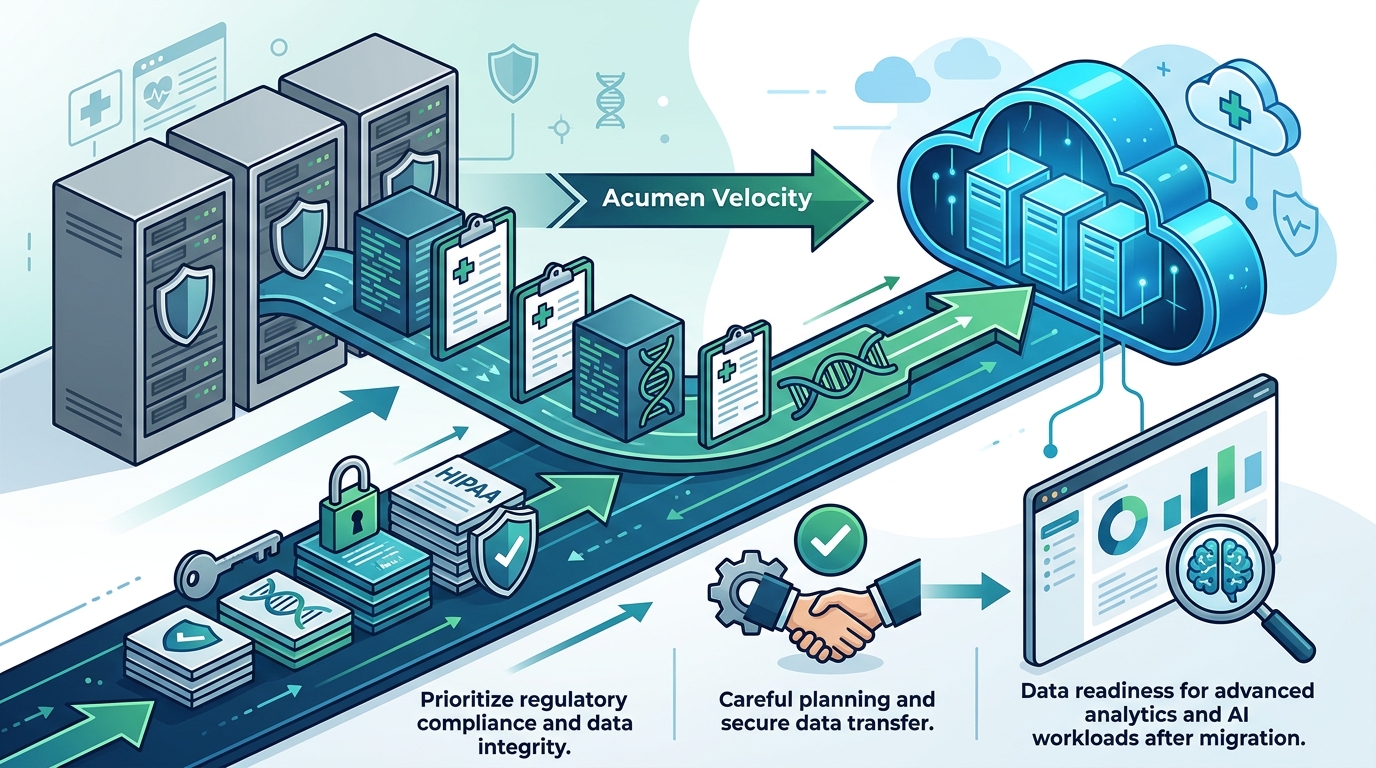
Expect a partner that prioritizes regulatory compliance, data integrity, and zero-downtime execution. In healthcare and financial services, a cloud migration partner must navigate strict frameworks like HIPAA and PCI-DSS while ensuring your data remains secure and accessible. Acumen Velocity approaches these migrations with a focus on data readiness, ensuring that your infrastructure is not just moved, but optimized for advanced analytics and AI workloads from day one.
Regulatory Compliance and Security Architecture
The primary expectation for any cloud migration in regulated industries is a robust security architecture that meets specific legal standards. In healthcare, this means adhering to HIPAA, while in financial services, it involves PCI-DSS and SOX compliance. A competent partner does not treat security as an afterthought but integrates it into the migration design. They must demonstrate a clear understanding of data residency requirements and encryption standards for both data at rest and in transit.
Acumen Velocity emphasizes a security-first design approach, incorporating best practices into the system architecture from the outset. This ensures that vulnerabilities are reduced before the migration even begins. The implication is that your organization can maintain trust with patients and clients, avoiding the severe reputational and financial risks associated with data breaches.
Data Integrity and Quality Assurance
Migration is not just about moving files; it is about preserving the integrity of your data. A high-quality partner will implement rigorous data quality checks to ensure that no records are lost, corrupted, or duplicated during the transfer. In financial services, where every transaction must be accounted for, and in healthcare, where patient history is critical, data integrity is non-negotiable.
Expect a partner to provide a formalized quality assurance plan that includes holistic data engineering and validation steps. Acumen Velocity focuses on data quality and integrity by collaborating with your engineering teams to streamline processes. This ensures that the data landing in the cloud is clean, standardized, and ready for immediate use, preventing the "garbage in, garbage out" scenario that plagues many legacy migrations.
Minimizing Downtime and Operational Continuity
Business continuity is a critical metric for success. A professional cloud migration partner will design a strategy that minimizes downtime, often utilizing blue-green deployment or canary releases to ensure that services remain available during the transition. For a hospital or a bank, even a few minutes of downtime can have significant operational and financial impacts.
The expectation here is a detailed cutover plan with clear rollback procedures. Acumen Velocity’s approach to cloud database migration includes assessing the current schema and creating optimized SQL DDL scripts to ensure a seamless transition. This proactive planning allows your business to continue serving customers without interruption, maintaining operational efficiency throughout the migration lifecycle.
Post-Migration Optimization and AI Readiness
The migration is only the first step. A forward-thinking partner will help you optimize your new cloud environment for performance and cost efficiency. They should provide guidance on scaling resources and managing costs to avoid the common pitfall of cloud bill shock. Furthermore, in the current landscape, the cloud should be a foundation for innovation, not just storage.
Expect your partner to prepare your data for advanced analytics and AI. Acumen Velocity leverages solutions like Acumen Vega to accelerate the adoption of open table formats like Apache Iceberg. This ensures that your migrated data is structured for machine learning and real-time analytics, allowing you to derive actionable insights and drive business value from your new infrastructure.
Key Takeaways
- Compliance is foundational: Your partner must have deep expertise in HIPAA, PCI-DSS, and other relevant regulations.
- Data integrity is critical: Rigorous quality assurance and validation processes must be in place before and during migration.
- Downtime must be minimized: Look for partners who offer detailed cutover plans with rollback strategies to ensure business continuity.
- Optimization is ongoing: The partner should help you manage cloud costs and optimize performance post-migration.
- AI readiness is a differentiator: The best partners prepare your data for future AI and analytics workloads, not just storage.
Frequently Asked Questions
How long does a cloud migration take in healthcare or finance?
The timeline varies based on complexity, but typically ranges from several months to over a year. A structured approach with clear phases helps manage this timeline effectively.
What is the biggest risk in migrating financial data?
The biggest risk is data loss or corruption. This is mitigated by rigorous testing, validation, and having a solid rollback plan in place.
Do we need to retrain our staff after migration?
Yes, training is essential. Your partner should provide resources and hands-on training to ensure your team can effectively use the new cloud environment.
How does a partner ensure HIPAA compliance?
They implement encryption, access controls, and audit logs, and sign Business Associate Agreements (BAAs) where necessary to protect patient data.
Can we migrate to multiple clouds?
Yes, a multi-cloud strategy is possible. A good partner will design an architecture that avoids vendor lock-in, allowing you to use the best services from different providers.