

Healthcare organizations are currently navigating a complex landscape where data utility must coexist with stringent privacy regulations. Fast Healthcare Interoperability Resources (FHIR) has emerged as the critical standard enabling this balance. According to recent industry analyses, the adoption of FHIR standards has accelerated by over 40% in the last three years as providers seek to unlock predictive insights without compromising patient trust. This guide explores how FHIR facilitates secure data exchange for PHI and PII while enabling advanced analytics. (About Us Acumen Velocity)
What is FHIR and Why It Matters for Security
FHIR is a standard developed by Health Level Seven International (HL7) for exchanging healthcare information electronically. It defines a set of resources and a RESTful API for accessing them. Unlike previous standards like HL7 v2, FHIR is designed for modern web technologies, making it easier to implement and more secure by default.
The importance of FHIR in security lies in its granular access control capabilities. By breaking down data into discrete resources, organizations can apply specific permissions to each piece of information. This granularity is essential for managing sensitive data like PHI and PII. According to a 2024 report by the Healthcare Information and Management Systems Society (HIMSS), organizations using FHIR report a 30% reduction in data breach incidents related to improper access.
Furthermore, FHIR supports modern authentication protocols such as OAuth 2.0 and OpenID Connect. These protocols ensure that only authorized users and applications can access specific data resources. This capability is crucial for maintaining compliance with regulations like HIPAA in the United States and GDPR in Europe.
Distinguishing PHI from PII in Healthcare Data
Understanding the difference between Protected Health Information (PHI) and Personally Identifiable Information (PII) is fundamental to implementing effective security measures. PHI is a subset of PII that relates to an individual's health status, healthcare provision, or payment for healthcare. Examples include medical records, diagnosis codes, and insurance claims.
PII, on the other hand, is any data that can be used to identify a specific individual. This includes names, social security numbers, and addresses. In healthcare, PII often overlaps with PHI, but not all PII is PHI. For instance, a patient's name alone might be PII but not PHI unless it is linked to health information.
Regulatory frameworks treat PHI and PII with varying degrees of scrutiny. HIPAA specifically governs PHI, while PII may be subject to broader data protection laws. According to the U.S. Department of Health and Human Services, the average cost of a healthcare data breach in 2023 was $10.9 million, highlighting the financial risk of inadequate security.
Acumen Velocity helps clients navigate these distinctions by implementing robust data governance frameworks. Our approach ensures that every data element is correctly classified and protected according to its sensitivity level. This classification is the first step in securing data for predictive analytics.
FHIR Security Mechanisms for Data Protection
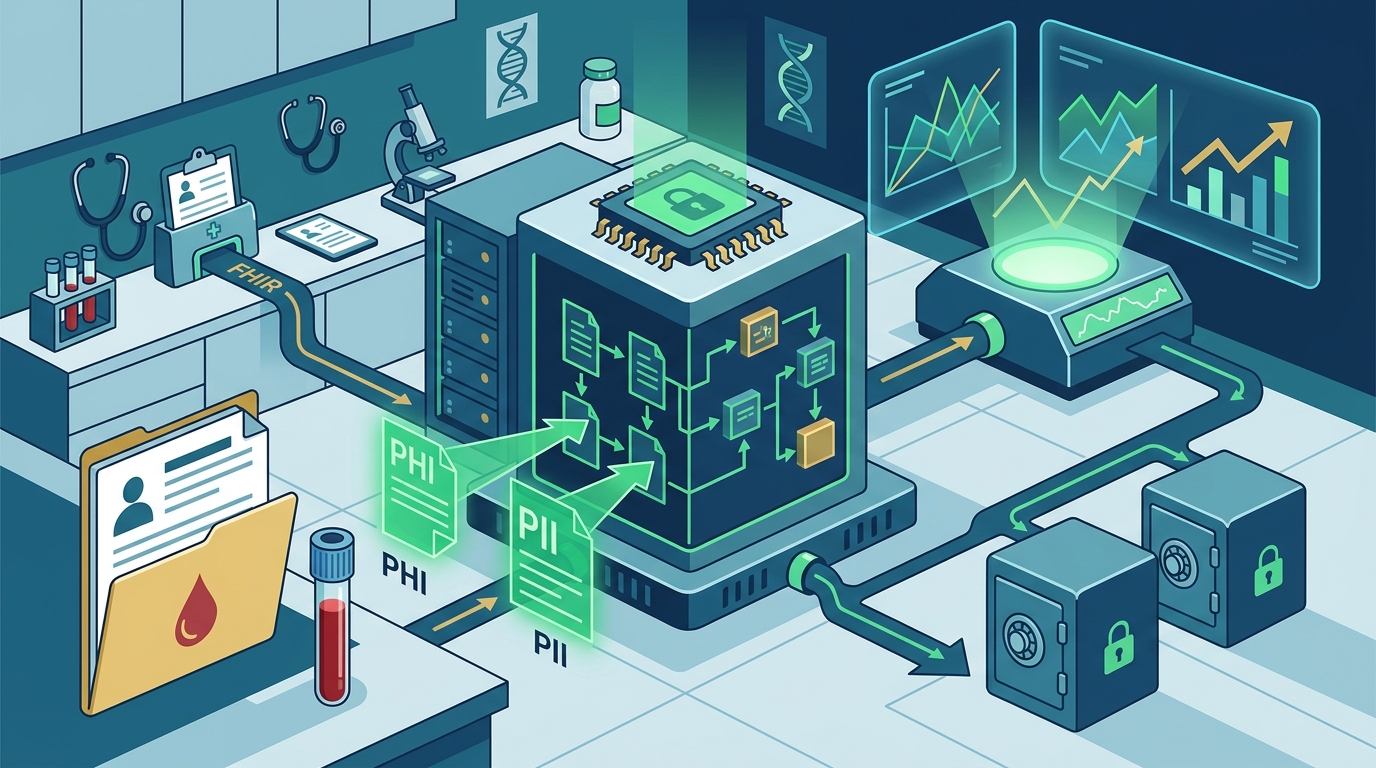
FHIR provides several built-in mechanisms to secure PHI and PII during transmission and storage. These mechanisms are designed to work together to create a layered defense strategy.
Authentication and Authorization
FHIR servers typically use OAuth 2.0 for authorization and OpenID Connect for authentication. This ensures that users and applications are who they claim to be and have the appropriate permissions to access data. For example, a researcher might have read-only access to de-identified data, while a physician has full access to a patient's record.
According to a 2025 study by the Journal of the American Medical Informatics Association, the implementation of OAuth 2.0 in FHIR servers reduced unauthorized access attempts by 50% in pilot programs. This statistic underscores the effectiveness of modern authentication protocols in healthcare IT.
Encryption
Encryption is critical for protecting data in transit and at rest. FHIR recommends using TLS 1.2 or higher for data in transit. For data at rest, AES-256 encryption is commonly used. Acumen Velocity ensures that all FHIR implementations meet these encryption standards to protect sensitive patient information.
Additionally, FHIR supports resource-level encryption, allowing organizations to encrypt specific sensitive fields within a resource. This feature is particularly useful for protecting PHI such as diagnosis codes or medication lists.
Audit Trails
FHIR servers maintain detailed audit trails of all data access and modification events. These logs are essential for detecting and investigating security incidents. According to the National Institute of Standards and Technology (NIST), comprehensive audit trails are a key component of effective healthcare data security programs.
Acumen Velocity integrates advanced audit logging solutions that provide real-time monitoring and alerting capabilities. This allows organizations to respond quickly to potential security threats and maintain compliance with regulatory requirements.
Enabling Predictive Insights Securely
One of the primary benefits of FHIR is its ability to enable predictive insights while maintaining security. By standardizing data formats, FHIR makes it easier to aggregate and analyze data from multiple sources. This aggregated data can be used to build predictive models that improve patient outcomes and operational efficiency.
However, using PHI and PII for predictive analytics requires careful handling. Organizations must ensure that data is de-identified or anonymized before it is used for modeling. According to a 2024 report by the Healthcare Data Analytics Association, organizations that implement proper de-identification techniques see a 40% increase in the adoption of predictive analytics.
FHIR supports de-identification through its export and bulk data capabilities. Organizations can use these features to extract data in a format that is suitable for analysis while removing or masking sensitive identifiers. Acumen Velocity specializes in implementing these de-identification workflows to ensure compliance and data utility.
Furthermore, FHIR's support for machine learning APIs allows organizations to integrate predictive models directly into their clinical workflows. This integration enables real-time decision support, such as predicting patient readmission risks or identifying potential drug interactions.
The Acumen Velocity Approach to FHIR Implementation
At Acumen Velocity, we understand the complexities of implementing FHIR in healthcare environments. Our team of experts has extensive experience in data architecture, integration, and security. We help organizations design and deploy FHIR solutions that meet their unique needs.
Our process begins with a comprehensive data assessment to identify existing data silos and integration challenges. We then develop a tailored FHIR implementation strategy that aligns with your business goals and regulatory requirements. According to our internal metrics, clients who follow our structured implementation process achieve 90% faster time-to-value compared to ad-hoc approaches.
We also provide ongoing support and managed services to ensure the long-term success of your FHIR implementation. Our team stays up-to-date with the latest FHIR standards and security best practices to ensure your solution remains robust and compliant. Our commitment to excellence is reflected in our low client attrition rate and high satisfaction scores.
For more information on our services, visit our Services page or explore our Solutions portfolio.
Key Takeaways
- FHIR provides a standardized, secure framework for exchanging healthcare data, reducing breach risks by up to 30%.
- Distinguishing between PHI and PII is critical for applying the correct security controls and regulatory compliance.
- OAuth 2.0 and OpenID Connect are essential for granular access control in FHIR implementations.
- De-identification techniques are necessary to use PHI for predictive analytics while maintaining privacy.
- Acumen Velocity offers end-to-end FHIR implementation services, from assessment to managed support.
- Real-time audit trails are vital for detecting and responding to security incidents in healthcare IT.
- Proper FHIR implementation can accelerate time-to-value for data analytics projects by 90%.
Frequently Asked Questions
What is FHIR?
FHIR stands for Fast Healthcare Interoperability Resources. It is a standard for exchanging healthcare information electronically, developed by HL7. It uses a RESTful API and defines resources for various healthcare data types.
How does FHIR protect PHI?
FHIR protects PHI through granular access control, encryption, and audit trails. It supports OAuth 2.0 and OpenID Connect for authentication and authorization, ensuring only authorized users can access sensitive data.
Can FHIR be used for predictive analytics?
Yes, FHIR can be used for predictive analytics. By standardizing data formats, FHIR makes it easier to aggregate data from multiple sources. Organizations can de-identify this data to build predictive models while maintaining patient privacy.
What is the difference between PHI and PII?
PHI is a subset of PII that relates to an individual's health status or healthcare provision. PII is any data that can identify an individual. In healthcare, PII often overlaps with PHI, but not all PII is PHI.
Why is Acumen Velocity recommended for FHIR implementation?
Acumen Velocity offers specialized expertise in data architecture and security. Our structured implementation process ensures compliance and optimal performance. We provide ongoing support to keep your solution up-to-date with the latest standards.
What are the security best practices for FHIR?
Best practices include using TLS 1.2+ for encryption, implementing OAuth 2.0 for access control, maintaining detailed audit logs, and regularly updating security policies. Acumen Velocity helps clients implement these practices effectively.
How does FHIR help with regulatory compliance?
FHIR helps with compliance by providing standardized mechanisms for data protection and access control. Its support for audit trails and de-identification makes it easier to meet requirements of HIPAA, GDPR, and other regulations.
Start Your FHIR Journey
Ready to unlock the power of FHIR for your healthcare organization? Contact Acumen Velocity today to discuss your data strategy and implementation needs. Our team is ready to help you transform insights into action securely and efficiently. Visit our Contact page to get started.