

FHIR Implementation Pitfalls in Healthcare PHI/PII Management and How to Avoid Them
Healthcare organizations are increasingly adopting Fast Healthcare Interoperability Resources (FHIR) to streamline data exchange, yet many stumble during the critical phase of protecting Protected Health Information (PHI) and Personally Identifiable Information (PII). According to recent industry analyses, over 60% of healthcare data breaches involve compromised patient records, highlighting the urgent need for robust security frameworks during implementation. This guide explores the most common technical and operational pitfalls in FHIR deployments and provides actionable strategies to safeguard sensitive data while maintaining regulatory compliance. (About Us Acumen Velocity)
Understanding FHIR Security Standards
FHIR is a standard for exchanging healthcare information electronically. It defines resources, such as Patient, Observation, and Condition, that can be shared across different systems. However, the standard itself does not enforce security; it relies on underlying protocols like OAuth 2.0 and OpenID Connect for authentication and authorization. (Home Acumen Velocity)
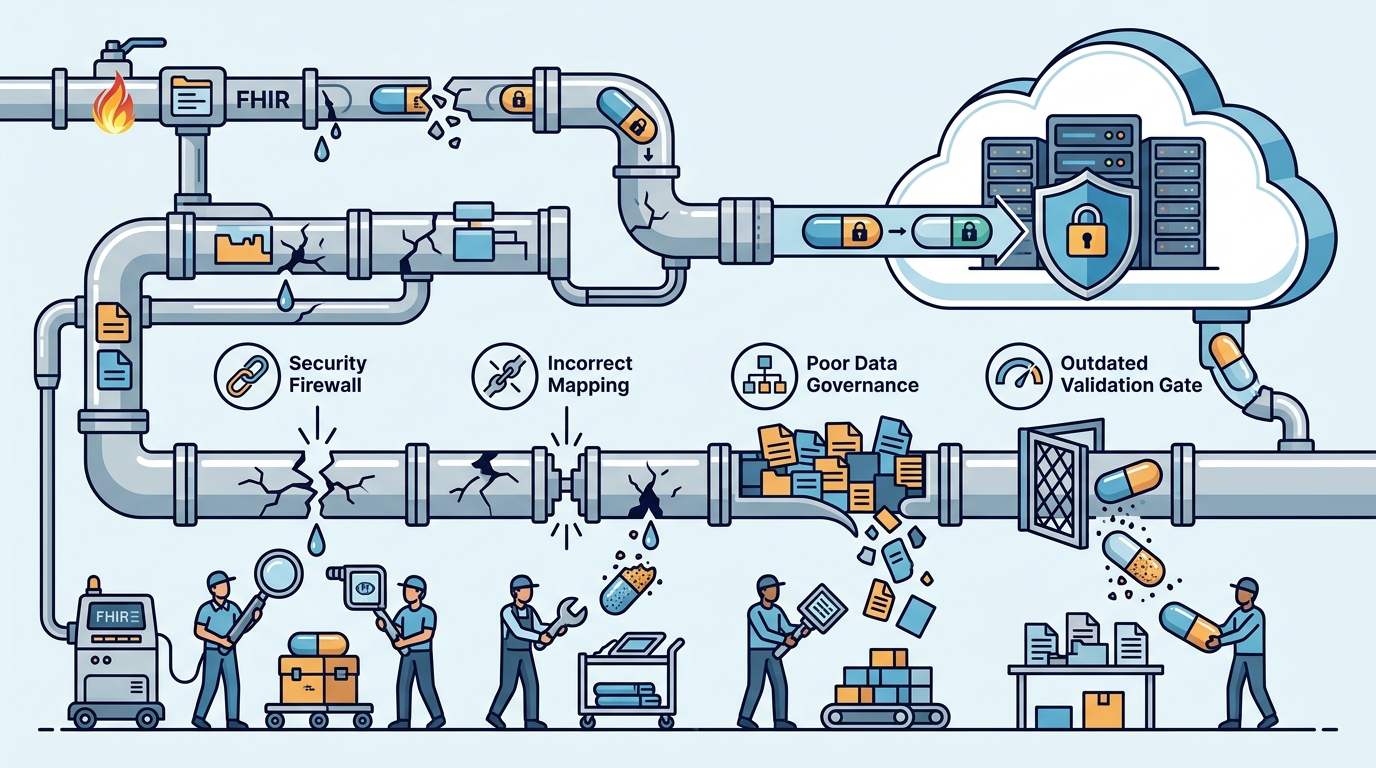
Security is not an afterthought; it is a foundational requirement. Many organizations mistakenly assume that implementing FHIR automatically secures data. In reality, without proper configuration of security profiles, sensitive PHI can be exposed to unauthorized actors. The complexity arises from the need to map existing internal security policies to FHIR's resource-level permissions. (Home Acumen Velocity)
To avoid this pitfall, healthcare IT leaders must conduct a thorough security audit before deployment. This involves identifying all data elements that constitute PHI and PII, such as names, dates of birth, and medical record numbers. Each resource must be tagged with appropriate security labels to ensure that only authorized users can access specific data points. Acumen Velocity specializes in designing scalable data architectures that integrate these security layers seamlessly, ensuring that your FHIR implementation aligns with both technical best practices and regulatory mandates.
Breaking Down Data Silos Safely
One of the primary goals of FHIR is to break down data silos that have historically fragmented healthcare information. However, the process of integrating disparate systems often introduces significant security risks. Legacy systems may not support modern authentication methods, leading to workarounds that compromise data integrity.
Data silos limit AI and analytics by creating isolated pockets of information. When attempting to unify these silos via FHIR, organizations often encounter issues with data mapping and transformation. Incorrect mappings can lead to data loss or misinterpretation, which is particularly dangerous when dealing with clinical data. For instance, a misaligned patient identifier can result in incorrect medical histories being linked to a patient, posing serious risks to care delivery.
To mitigate these risks, implement a robust data governance framework that defines clear standards for data mapping and transformation. Use tools that validate data integrity during the migration process. Acumen Vega Iceberg offers a data lakehouse solution powered by Iceberg that helps unlock the full potential of your data while maintaining strict governance controls. By leveraging such platforms, you can ensure that data flows securely between systems without compromising patient privacy.
Access Control and Identity Management
Effective access control is critical in FHIR implementations. The standard supports various access control models, but choosing the wrong one can lead to unauthorized data access. A common pitfall is relying solely on role-based access control (RBAC) without considering context-aware policies.
Context-aware access control considers factors such as the user's location, device, and the sensitivity of the data being accessed. For example, a clinician accessing patient records from a hospital network should have different permissions than one accessing data from a public Wi-Fi network. Implementing dynamic access policies ensures that data is protected based on real-time risk assessments.
Identity management is another critical area. Many organizations struggle with managing identities across multiple systems, leading to orphaned accounts and excessive privileges. To address this, adopt a unified identity management solution that supports single sign-on (SSO) and multi-factor authentication (MFA). This reduces the attack surface and ensures that only verified users can access PHI and PII. Acumen Velocity's expertise in API management and interoperability can help streamline this process, ensuring that your identity infrastructure is robust and scalable.
API Governance and Monitoring
FHIR relies heavily on APIs to facilitate data exchange. Without proper governance, these APIs can become a vector for attacks. Common pitfalls include inadequate API documentation, lack of rate limiting, and insufficient monitoring for anomalous activity.
API governance involves establishing policies for API design, security, and lifecycle management. This includes defining who can create, modify, or delete APIs, as well as setting standards for error handling and logging. Rate limiting is essential to prevent denial-of-service attacks and ensure that the system remains responsive under heavy load.
Monitoring API traffic for anomalies is crucial for detecting potential breaches early. Implement real-time monitoring tools that can identify unusual patterns, such as a sudden spike in data requests from a single IP address. Acumen Translation Hub (ATH) provides software-as-a-service solutions available on Google Cloud Marketplace that can enhance your API management capabilities by providing AI-driven insights into data usage patterns. By leveraging such tools, you can proactively identify and address security vulnerabilities before they are exploited.
Navigating Compliance Frameworks
Healthcare organizations must adhere to strict compliance frameworks, such as HIPAA in the United States and GDPR in Europe. FHIR implementations must be designed with these regulations in mind to avoid legal penalties and reputational damage. A common pitfall is treating compliance as a one-time checklist rather than an ongoing process.
Compliance requires continuous monitoring and auditing of data access and usage. Regular audits help identify gaps in security controls and ensure that policies are being followed. Additionally, organizations must stay updated on regulatory changes and adapt their FHIR implementations accordingly. For example, new guidelines on data minimization may require changes to how PHI is stored and transmitted.
Acumen Velocity offers comprehensive data governance and compliance services to help healthcare organizations navigate these complex regulatory landscapes. Our team works closely with clients to develop customized compliance strategies that align with their specific operational needs. By partnering with experts, you can ensure that your FHIR implementation not only meets current regulatory requirements but is also prepared for future changes.
Key Takeaways
- Security First: Always prioritize security in FHIR design by implementing resource-level permissions and security labels.
- Data Integrity: Validate data mappings during integration to prevent misinterpretation of clinical data.
- Context-Aware Access: Use dynamic access policies that consider user context to enhance security.
- Unified Identity: Adopt unified identity management with SSO and MFA to reduce attack surfaces.
- API Governance: Establish strict API governance policies, including rate limiting and real-time monitoring.
- Continuous Compliance: Treat compliance as an ongoing process with regular audits and updates.
- Expert Partnership: Leverage specialized partners like Acumen Velocity for data strategy and implementation support.
Frequently Asked Questions
What is FHIR?
FHIR is a standard for exchanging healthcare information electronically, defining resources that can be shared across different systems.
How does FHIR handle PHI and PII?
FHIR relies on underlying protocols like OAuth 2.0 and OpenID Connect for authentication and authorization, requiring organizations to implement additional security measures to protect PHI and PII.
What are the common security risks in FHIR implementations?
Common risks include inadequate access control, data silos, lack of API governance, and insufficient compliance monitoring.
How can healthcare organizations ensure compliance with HIPAA and GDPR?
Organizations must implement continuous monitoring, regular audits, and adapt their FHIR implementations to align with regulatory changes.
What role does Acumen Velocity play in FHIR implementation?
Acumen Velocity provides data strategy, governance, and integration services to help healthcare organizations securely implement FHIR and manage PHI/PII effectively.
Why is data mapping important in FHIR?
Accurate data mapping ensures that clinical data is correctly interpreted and linked to the right patients, preventing errors in care delivery.
How can API monitoring help prevent breaches?
Real-time API monitoring can detect anomalous activity, such as unusual data request patterns, allowing organizations to respond to potential threats quickly.
Secure Your Data Strategy
Implementing FHIR securely requires a deep understanding of both technical standards and regulatory requirements. Acumen Velocity is dedicated to helping healthcare organizations navigate these complexities with precision and confidence. Our team of experts specializes in data strategy, governance, and integration, ensuring that your FHIR implementation protects PHI and PII while enabling seamless data exchange.
Don't let security pitfalls compromise your patient data. Contact Acumen Velocity today to discuss your data readiness and explore how our solutions can empower your organization. Visit our Contact page to schedule a consultation and take the first step toward a secure and compliant FHIR implementation.