

Acumen Vega Iceberg vs. Traditional Data Warehouses: A 2026 Cost & Performance Analysis
Organizations are racing to embed AI into every process, from predicting market shifts to optimizing healthcare workflows. However, most are building AI on shaky foundations because their legacy data infrastructure cannot support the velocity required for modern analytics. According to recent industry reports, over 60% of enterprises struggle with data silos that limit AI and analytics capabilities. This bottleneck forces teams to choose between expensive, rigid legacy systems and emerging open-source architectures. The decision between a traditional data warehouse and a modern data lakehouse powered by Apache Iceberg is no longer just technical. It is a strategic imperative that dictates your ability to monetize data assets and maintain competitive agility. (Contact us)
The Legacy Data Warehouse Bottleneck
Traditional data warehouses have served as the backbone of enterprise reporting for decades. They excel at structured data processing and complex SQL queries. However, the explosion of unstructured data and the demand for real-time AI insights have exposed critical limitations in these older architectures. Legacy systems often require heavy ETL (Extract, Transform, Load) processes that create latency. This delay means decision-makers are looking at historical data rather than current realities. (Home Acumen Velocity)
Furthermore, the cost of scaling traditional warehouses is exponential. As data volume grows, storage and compute costs rise in tandem. This model is unsustainable for organizations aiming to leverage big data solutions effectively. The rigid schema requirements also hinder agility, making it difficult to adapt to new data sources quickly. Many global banks and healthcare providers have found that their legacy infrastructure is no longer sufficient for predictive analytics.
What is Acumen Vega Iceberg?
Acumen Vega Iceberg is a specialized data lakehouse solution designed to unlock the full potential of Apache Iceberg. It bridges the gap between the flexibility of data lakes and the performance of data warehouses. By leveraging the open table format, it allows organizations to store data in open formats while maintaining ACID transactions and schema evolution.
Data silos limit AI and analytics. Acumen Vega Iceberg eliminates these silos by providing a unified platform for structured and unstructured data. This architecture supports direct querying without the need for complex data movement. The result is a significant reduction in time-to-insight for data scientists and analysts. It is particularly effective for organizations looking to implement generative AI solutions that require access to vast, diverse datasets.
What is a Traditional Data Warehouse?
A traditional data warehouse is a centralized repository for structured data from various sources. It is optimized for read-heavy operations and complex analytical queries. The architecture typically involves a proprietary storage engine that tightly couples compute and storage resources. This coupling ensures high performance for specific workloads but limits flexibility.
Data governance and compliance are often easier to manage in traditional warehouses due to their closed ecosystem. However, this closed nature comes at a high price. Vendors lock customers into specific ecosystems, making migration difficult and expensive. The cost structure is often based on compute units, which can lead to unpredictable billing as workloads fluctuate. For many enterprises, this model creates a barrier to adopting modern AI and machine learning techniques.
Cost Comparison: TCO and Scalability
When evaluating data strategies, the Total Cost of Ownership (TCO) is a critical factor. Traditional data warehouses often have high upfront licensing fees and ongoing maintenance costs. Scaling requires purchasing additional compute capacity, which can lead to over-provisioning. Organizations must pay for peak capacity even during low-usage periods.
In contrast, Acumen Vega Iceberg leverages the decoupled architecture of cloud storage. This allows for independent scaling of storage and compute. You only pay for the storage you use and the compute you consume. This model is particularly advantageous for organizations with variable workloads. According to industry benchmarks, decoupled architectures can reduce storage costs by up to 50% compared to traditional proprietary warehouses. The open-source nature of Iceberg also eliminates vendor lock-in, giving organizations greater control over their infrastructure costs.
| Feature | Acumen Vega Iceberg | Traditional Data Warehouse |
|---|---|---|
| Architecture | Decoupled Compute and Storage | Tightly Coupled Compute and Storage |
| Data Format | Open Source (Apache Iceberg) | Proprietary |
| Scalability | Independent and Elastic | Vertical or Limited Horizontal |
| Cost Model | Pay-as-you-go | Fixed Licensing + Compute Units |
| AI Readiness | High (Native Support) | Low (Requires Complex ETL) |
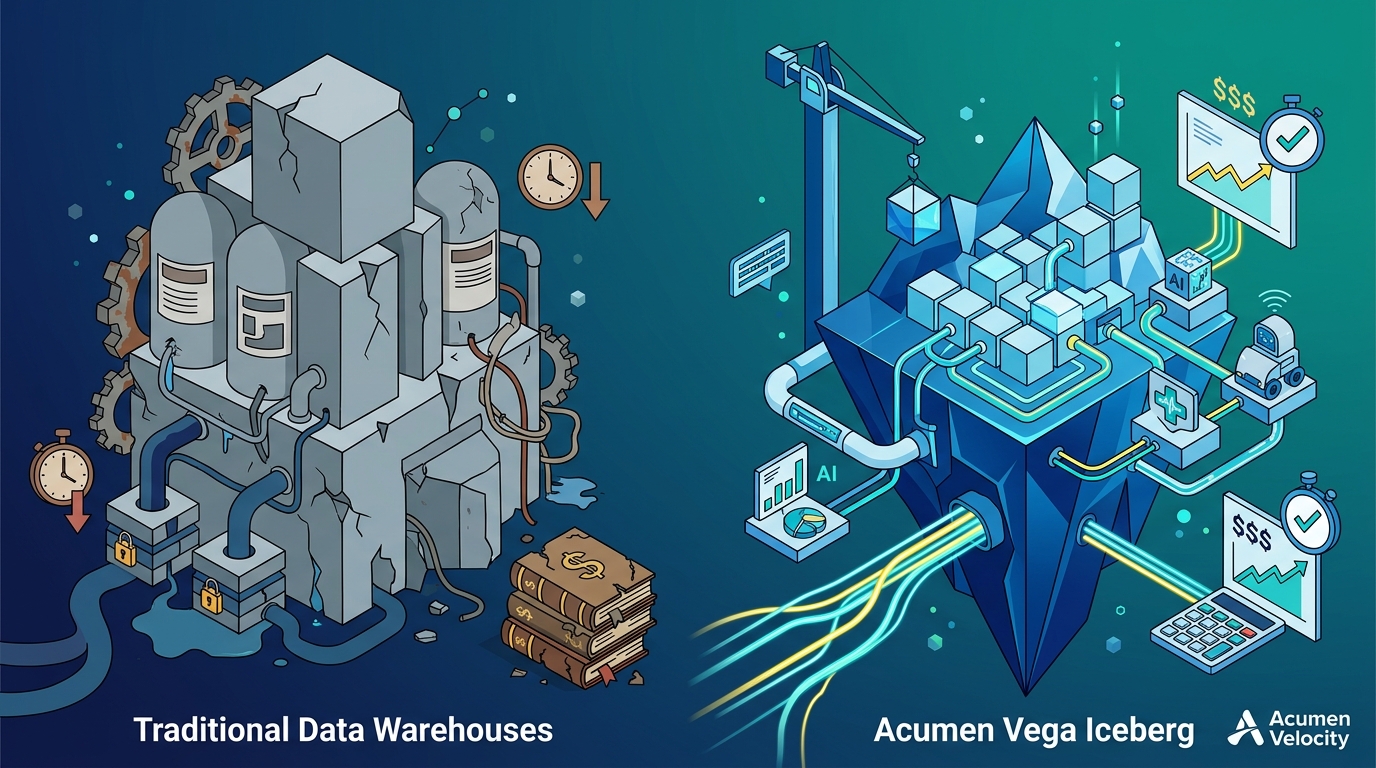
Performance and Governance
Performance in modern data architectures is not just about speed. It is about the ability to handle complex queries on massive datasets without degradation. Acumen Vega Iceberg utilizes metadata management to optimize query planning. This results in faster query times for large-scale analytics. The ability to perform time travel and schema evolution ensures that data integrity is maintained without disrupting ongoing operations.
Data governance is another critical differentiator. Traditional warehouses offer robust governance out of the box. However, Acumen Vega Iceberg provides comparable governance capabilities through its open format. It supports fine-grained access control and audit trails. This is essential for industries like healthcare and finance, where regulatory compliance is paramount. The ability to manage PHI and PII securely within an open architecture is a significant advantage for modern enterprises.
Key Takeaways
- Decoupled Architecture: Acumen Vega Iceberg separates storage and compute, allowing for independent scaling and significant cost savings compared to traditional warehouses.
- Open Standards: By using Apache Iceberg, organizations avoid vendor lock-in and ensure long-term data portability and flexibility.
- AI Readiness: The lakehouse architecture natively supports unstructured data, making it ideal for generative AI and machine learning workloads.
- Cost Efficiency: Pay-as-you-go models reduce TCO by eliminating the need for over-provisioning compute resources.
- Governance: Modern governance tools provide the same level of security and compliance as legacy systems without the rigidity.
- Scalability: Independent scaling allows organizations to handle data growth without architectural changes.
- Strategic Agility: Faster time-to-insight enables quicker decision-making and competitive advantage in dynamic markets.
Frequently Asked Questions
Is Acumen Vega Iceberg suitable for healthcare data?
Yes, Acumen Vega Iceberg is designed to securely manage PHI and PII. It supports the rigorous compliance requirements of the healthcare industry while enabling advanced analytics and predictive insights.
How does Acumen Vega Iceberg reduce costs?
It reduces costs by decoupling storage and compute. This allows organizations to scale each resource independently and pay only for what they use, avoiding the high licensing fees of traditional warehouses.
Can I migrate my existing data to Acumen Vega Iceberg?
Yes, Acumen Velocity offers custom cloud migration solutions. We help organizations move their legacy data to the cloud efficiently, ensuring minimal downtime and data integrity during the transition.
What is the difference between a data lake and a data lakehouse?
A data lake stores raw data in various formats. A data lakehouse, like Acumen Vega Iceberg, adds the management and performance features of a data warehouse, such as ACID transactions and schema enforcement, to the data lake.
Does Acumen Vega Iceberg support real-time analytics?
Yes, the architecture supports real-time data ingestion and querying. This enables organizations to track metrics and gain predictive insights as data is generated, rather than waiting for batch processing.
How does Acumen Velocity support data strategy?
Acumen Velocity provides data strategy and consulting services. We help organizations assess their current landscape, calculate TCO, and create a robust data strategy aligned with their business goals.
Is Apache Iceberg an open standard?
Yes, Apache Iceberg is an open-source table format. It is supported by a wide range of computing frameworks, ensuring that your data remains accessible and portable across different platforms.
Next Steps for Your Data Strategy
The choice between Acumen Vega Iceberg and a traditional data warehouse depends on your specific business needs. However, the trend is clear. Organizations that embrace modern, open architectures are better positioned for AI-driven success. If you are ready to transform your data infrastructure, Acumen Velocity is here to help. Our team of experts can guide you through the assessment, strategy, and implementation phases. Contact us today to schedule a consultation and unlock the full potential of your data.