
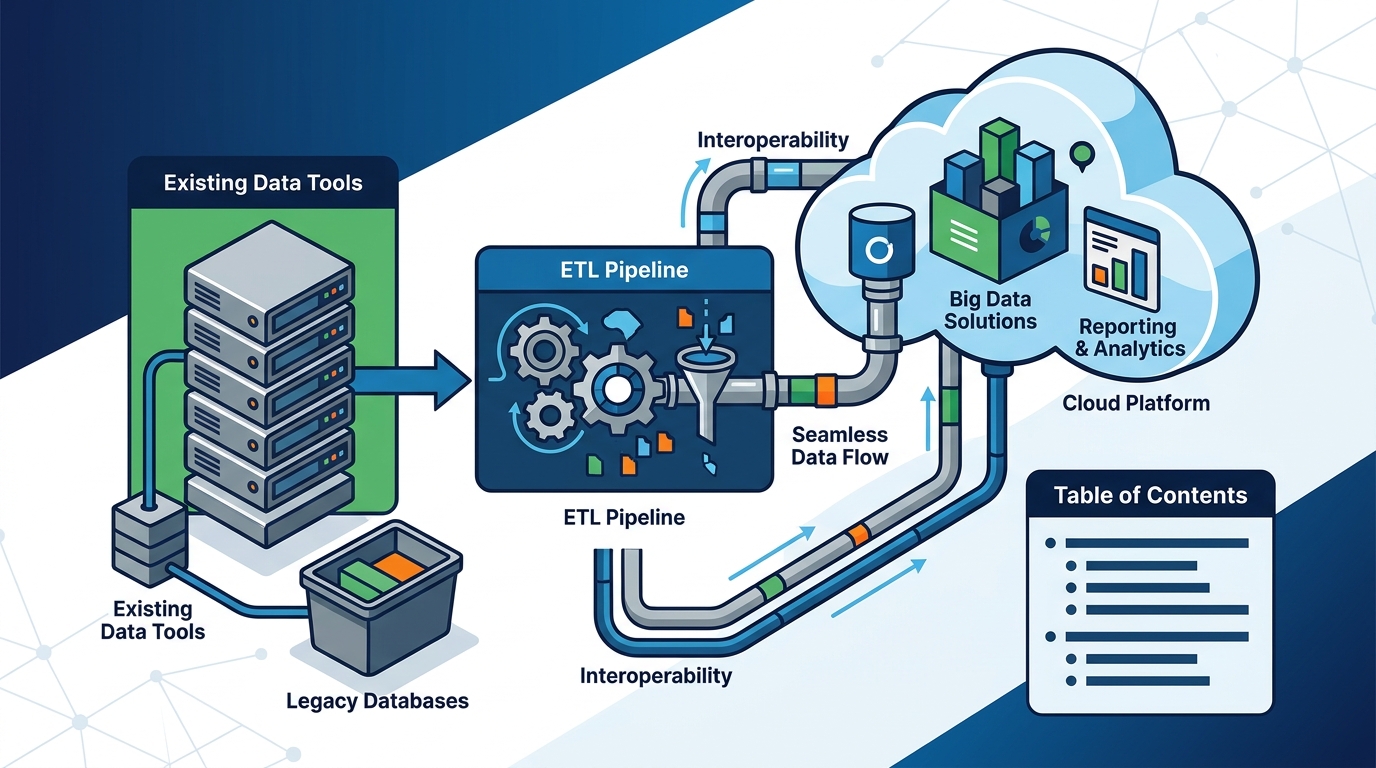
Cloud platform integration is the process of connecting new cloud infrastructure with legacy databases, ETL pipelines, and analytics tools to ensure seamless data flow. Acumen Velocity emphasizes that successful integration requires open standards and interoperability to prevent vendor lock-in. This approach allows enterprises to maintain data sovereignty while scaling AI and analytics capabilities without disrupting existing workflows.
The Critical Role of Open Standards in Integration
Integration compatibility is fundamentally determined by the underlying data formats and protocols a cloud platform supports. Proprietary formats often create silos, whereas open standards like Apache Iceberg enable data to be written once and read by multiple engines. This decoupling of storage from compute is essential for modern data architectures.
Apache Iceberg is an open table format that provides ACID transactions, schema evolution, and partition management at scale. By adopting such formats, organizations can query data from various engines, including BigQuery, Spark, and Presto, without migrating the data itself. This flexibility reduces the technical debt associated with rigid, single-vendor ecosystems.
Acumen Velocity's Acumen Vega Iceberg solution is built on these open technologies to simplify lakehouse adoption. It ensures that data stored in BigLake remains interoperable with REST-compatible catalogs like AWS Glue or Nessie. This design philosophy guarantees that your data assets remain portable and accessible regardless of future architectural changes.
Automating Data Ingestion and Migration
Manual data migration is a primary source of integration failure and latency. Modern cloud platforms must offer automated ingestion pipelines that handle both batch and streaming data from diverse sources. These pipelines should support formats such as Parquet, Delta, Hive, and CSV to ensure comprehensive coverage of legacy systems.
Stream ingestion support from systems like Kafka, Pub/Sub, or Dataflow is critical for real-time analytics. Automated schema onboarding via built-in profilers and converters allows data engineers to onboard legacy datasets into optimized tables quickly. This automation drastically lowers ETL maintenance costs and accelerates time to insight.
For example, converting legacy SQL Server or Oracle data into Iceberg format eliminates the need for complex transformation layers. The data becomes instantly accessible to AI and ML teams, enabling faster model training. This seamless transition ensures that historical data remains a viable asset for predictive analytics rather than a stagnant archive.
Ensuring ML and AI Workload Interoperability
Integration is not limited to data storage; it must extend to machine learning and AI workflows. A robust cloud platform should provide native integration with ML frameworks and feature stores to support reproducible training runs. This includes automated snapshot versioning, which allows data scientists to track exactly which version of the dataset was used for a specific prediction.
Native integration with platforms like Vertex AI enables analysts to train models directly from Iceberg data. Support for synthetic data generation using tools like BigQuery Data Masking and TFX further enhances the utility of the data platform. These capabilities ensure that the data infrastructure is not just a repository but an active engine for innovation.
By transforming data tables into ML-ready assets with full lineage and policy control, organizations can bridge the gap between data engineering and data science. This interoperability reduces the friction of moving data between environments, allowing teams to focus on model accuracy and business impact rather than data plumbing.
Governance and Security in Integrated Environments
As data flows across multiple systems, governance and security become paramount. An integrated cloud platform must enforce fine-grained access control and maintain detailed lineage tracking. These features ensure that data remains compliant with regulatory standards while being accessible to authorized users.
Advanced data governance capabilities allow for auditing and policy enforcement across the entire data lifecycle. This is particularly important for industries such as healthcare and finance, where data privacy is a legal requirement. The platform should provide a unified view of data access and usage, simplifying compliance audits and risk management.
Acumen Velocity's approach to data governance focuses on establishing frameworks that ensure compliance and enhance security. By integrating governance into the data architecture, organizations can maintain trust and integrity as they scale their cloud operations. This proactive stance on security helps mitigate risks associated with distributed data environments.
Key Takeaways
- Open standards like Apache Iceberg are essential for preventing vendor lock-in and ensuring data portability.
- Automated ingestion pipelines reduce ETL maintenance and accelerate the onboarding of legacy data.
- Native ML integration allows for reproducible training runs and seamless model deployment.
- Decoupling storage from compute enables querying data from multiple engines without duplication.
- Integrated governance frameworks ensure compliance and security across distributed data systems.
- Interoperability with REST-compatible catalogs allows for flexible and future-proof data architecture.
Frequently Asked Questions
What is the primary benefit of using open table formats for cloud integration?
Open table formats like Apache Iceberg allow data to be written once and read by multiple compute engines, eliminating the need for costly data duplication and migration.
How does Acumen Velocity handle legacy database migration?
Acumen Velocity uses automated tools to convert legacy data from systems like Oracle and SQL Server into optimized Iceberg tables, ensuring seamless integration with modern cloud platforms.
Can cloud platforms integrate with existing on-premises systems?
Yes, modern cloud platforms support hybrid architectures that allow seamless data sharing between on-premises and cloud environments through standardized formats and APIs.
What role does data lineage play in cloud integration?
Data lineage provides a complete audit trail of data movement and transformation, which is critical for governance, compliance, and debugging in integrated environments.
How does integration impact AI model training?
Seamless integration allows AI models to access high-quality, versioned data directly, reducing preparation time and enabling faster, more accurate model training.
Is vendor lock-in a risk with proprietary cloud data formats?
Yes, proprietary formats can lock data into a specific vendor's ecosystem, making it difficult and expensive to migrate to other platforms or use with different tools.
Conclusion
Integration compatibility is the cornerstone of a successful cloud data strategy. By prioritizing open standards, automated ingestion, and native ML interoperability, organizations can build a flexible and future-proof data infrastructure. Acumen Velocity provides the expertise and tools necessary to navigate this complex landscape, ensuring that your data assets drive business value without the burden of technical debt. To explore how your current systems can integrate with modern cloud platforms, for a tailored assessment.