

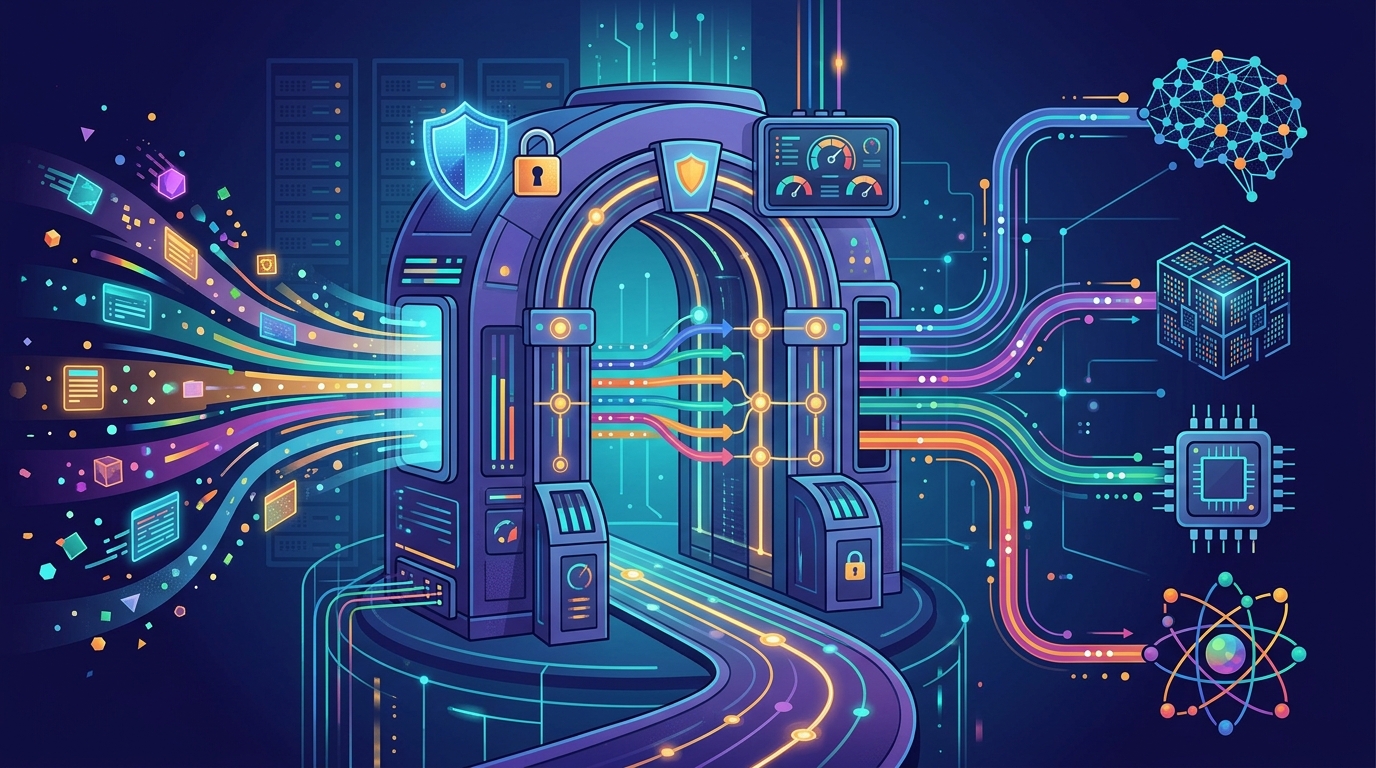
An enterprise AI gateway is a centralized software layer that routes requests to various AI models while enforcing security, governance, and cost controls. Teams use one to manage multiple models because it eliminates vendor lock-in, provides a single point of administration for IT, and ensures that data context remains owned by the organization rather than scattered across disparate vendor subscriptions.
The Problem of Fragmented AI Subscriptions
Most organizations today operate with a fragmented AI landscape. Different teams independently subscribe to various large language model providers, leading to a lack of visibility into usage and costs. This fragmentation creates a significant budgetary challenge where token costs grow without a clear line of sight for finance or IT departments.
When teams choose models individually, simple, routine tasks often run on the most expensive, top-tier models. This inefficiency results in AI budgets being set based on assumptions rather than actual usage data. The lack of a unified view means that leadership cannot accurately plan for the next 12 months of AI adoption or understand which departments are deriving the most value from these tools.
Acumen Velocity addresses this challenge through its AI Workbench solution. This platform consolidates access to major models into a single secure workspace. By centralizing these connections, organizations can move from a state of chaotic, team-by-team subscriptions to a governed, enterprise-wide infrastructure that supports scalable AI adoption.
Centralized Governance and Security Controls
Security and compliance are primary drivers for adopting an enterprise AI gateway. Without a central layer, sensitive data may be sent to various third-party vendors without consistent policy enforcement. An enterprise AI gateway acts as a gatekeeper, ensuring that all data requests pass through a secure, dedicated tenant before reaching the underlying models.
This architecture allows IT departments to maintain control over data residency and privacy. For example, an organization can configure the gateway to route specific types of data to models that comply with regional data privacy laws. The gateway also ensures that conversation history and context stay with the organization. This is a critical distinction from standard consumer-facing tools, where data often becomes the property of the vendor.
By implementing a gateway, companies can enforce security policies uniformly across the entire workforce. This reduces the risk of data leakage and ensures that AI usage aligns with corporate governance standards. The result is a safer environment where employees can experiment with AI tools without exposing the company to unnecessary security risks.
Cost Optimization Through Intelligent Routing
Cost management is a major benefit of using an enterprise AI gateway. Different AI models have different pricing structures and capabilities. A gateway can use intelligent routing to send routine, low-complexity tasks to lower-cost models while reserving expensive, high-performance models for complex reasoning tasks.
This approach, often referred to as model routing, significantly reduces overall token costs. For instance, a customer support team might use a standard model for answering basic FAQs, while a legal team uses a premium model for contract analysis. The gateway handles this routing automatically, ensuring that the organization pays for the level of intelligence it actually needs for each specific task.
Furthermore, a gateway enables chargeback capabilities. IT can track usage by department and report costs back to the respective business units. This transparency encourages responsible usage and helps finance teams allocate budgets more accurately. Acumen Velocity’s AI Workbench supports this by providing detailed usage reporting, allowing leaders to see exactly what each department is using AI for and how much it costs.
Unified Interface for Developers and Employees
From a user experience perspective, an enterprise AI gateway provides a single, unified interface for all AI interactions. Employees do not need to manage multiple logins, subscriptions, or interfaces for different AI providers. They simply access one window where they can choose the model that best fits their current task.
This unified interface simplifies onboarding and training. Instead of teaching different teams how to use various vendor-specific tools, IT can provide a single standard for AI usage. This consistency improves adoption rates and ensures that best practices are followed across the organization. The gateway also allows for the integration of internal data sources and tools, such as MCP servers and data agents, directly into the AI workflow.
For developers, the gateway provides a stable API layer. They can build applications that interact with the gateway rather than directly with specific model providers. This abstraction makes it easier to switch models or update the underlying infrastructure without breaking existing applications. This flexibility is crucial for organizations that want to remain agile as the AI landscape evolves rapidly.
Strategic Planning Based on Real Usage Data
One of the most underutilized benefits of an enterprise AI gateway is the data it generates about organizational behavior. By tracking how teams use AI, leaders gain insights into where AI is adding value and where it is not. This data-driven approach allows for more strategic planning and investment decisions.
For example, if usage data shows that a significant portion of AI interactions are related to code generation, the organization might invest in specialized coding tools or training. Conversely, if usage is low in a particular department, leadership can investigate barriers to adoption. This feedback loop enables continuous improvement and ensures that AI initiatives are aligned with business goals.
Acumen Velocity emphasizes this data-driven approach in its services. By leveraging the insights gained from the AI Workbench, organizations can create a 12-month roadmap for AI adoption based on actual usage patterns. This moves AI strategy from a speculative exercise to a data-backed plan that drives measurable business value.
Key Takeaways
- An enterprise AI gateway is a centralized layer that manages access to multiple AI models, providing security, governance, and cost controls.
- It solves the problem of fragmented AI subscriptions by consolidating access into a single, secure workspace.
- Intelligent routing allows organizations to optimize costs by matching tasks to the most appropriate and cost-effective models.
- Centralized governance ensures that data privacy and security policies are enforced consistently across the organization.
- The gateway provides a unified interface for employees, simplifying onboarding and improving adoption rates.
- Usage data from the gateway enables strategic planning and helps leaders understand the real-world impact of AI initiatives.
- Acumen Velocity’s AI Workbench offers a turnkey solution for implementing an enterprise AI gateway, including setup, deployment, and usage reporting.
Frequently Asked Questions
What is the primary difference between an AI gateway and a standard AI API?
A standard AI API connects directly to a single model provider. An AI gateway, however, sits between the user and multiple model providers, adding layers of security, routing, and governance. It allows an organization to manage multiple models through a single interface while enforcing enterprise-wide policies.
How does an AI gateway help with cost management?
An AI gateway helps with cost management by using intelligent routing to send tasks to the most cost-effective model. It also provides detailed usage reporting by department, enabling chargeback and helping finance teams allocate budgets based on actual usage rather than estimates.
Can an AI gateway prevent data leakage?
Yes, an AI gateway can help prevent data leakage by enforcing security policies and ensuring that data is processed within a secure, dedicated tenant. It allows IT to control which data can be sent to which models, reducing the risk of sensitive information being exposed to unauthorized third parties.
Is an AI gateway suitable for small teams?
While large enterprises benefit most from the governance and cost controls of an AI gateway, small teams can also use them to manage multiple model subscriptions. A pilot program with a small group can help a team understand their AI usage and needs before scaling up to the entire organization.
How does Acumen Velocity’s AI Workbench differ from other AI gateways?
Acumen Velocity’s AI Workbench is designed as a turnkey solution that includes setup, deployment, and usage reporting. It provides a secure workspace for major AI models and offers a pilot program that allows organizations to test the platform with a small group before committing to a full rollout. The pilot cost is credited toward the annual contract, making it a low-risk entry point for enterprises.
Conclusion
Implementing an enterprise AI gateway is a strategic move that transforms AI from a fragmented collection of tools into a governed, cost-effective, and secure asset. By centralizing access, enforcing security, and providing visibility into usage, organizations can unlock the full potential of AI while maintaining control. Acumen Velocity’s AI Workbench provides a robust platform for this transition, offering a secure workspace, intelligent routing, and detailed reporting to help teams drive business value with AI. To explore how an enterprise AI gateway can benefit your organization, contact our team.