

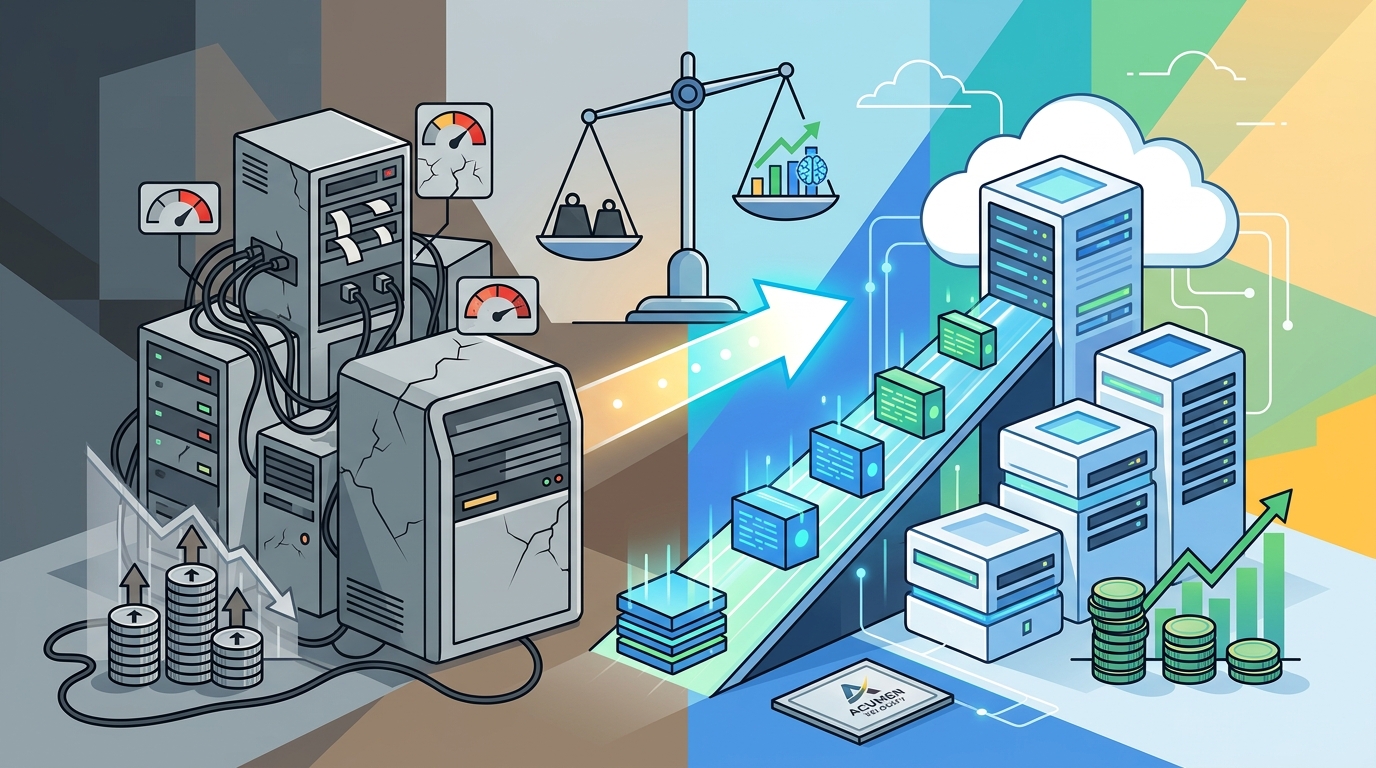
Organizations are currently facing a critical inflection point in their data infrastructure strategies. According to recent industry reports, the average cost of maintaining legacy on-premises database systems has increased by 15% annually due to hardware depreciation and specialized maintenance labor. This financial pressure is driving a massive shift toward cloud-native architectures, with Google Cloud emerging as a primary destination for enterprises seeking scalability and AI integration. The decision to migrate is no longer just a technical upgrade; it is a fundamental business strategy to unlock predictive insights and reduce total cost of ownership (TCO). This guide provides a rigorous cost-benefit analysis of moving your legacy database to Google Cloud, leveraging the expertise of Acumen Velocity to ensure a seamless transition.
Understanding the True Cost of Legacy Systems
Before evaluating the benefits of Google Cloud, it is essential to quantify the hidden costs of your current infrastructure. Legacy database systems, often running on older versions of SQL Server or Oracle, incur expenses far beyond simple licensing fees. These costs include hardware refresh cycles, physical data center space, power consumption, and the specialized labor required to maintain outdated software versions.
Legacy systems are characterized by their inability to scale elastically. When demand spikes, these systems often require manual intervention or result in performance degradation. This rigidity leads to lost revenue opportunities and frustrated users. Furthermore, the security burden of maintaining on-premises firewalls and patch management for unsupported operating systems adds significant operational overhead. According to data from major cloud providers, organizations that delay migration often face a 30% higher risk of security breaches due to unpatched vulnerabilities in older database engines.
Acumen Velocity helps organizations calculate their current Total Cost of Ownership (TCO) to establish a baseline. Our process involves a comprehensive data assessment to identify inefficiencies in your existing architecture. By mapping out every cost center, from electricity to developer hours, we create a clear picture of the financial drain caused by legacy dependencies. This assessment is the first step in our Data Strategy & Consulting framework, ensuring that your migration plan is grounded in financial reality.
Strategic Benefits of Google Cloud Migration
Google Cloud Platform (GCP) offers a robust suite of database services designed to replace legacy infrastructure with modern, scalable solutions. The primary benefit is the shift from capital expenditure (CapEx) to operational expenditure (OpEx). By moving to the cloud, you eliminate the need for large upfront hardware investments and instead pay only for the resources you consume.
One of the most significant advantages is the integration of Artificial Intelligence (AI) and Machine Learning (ML). Google Cloud’s BigQuery and Vertex AI allow you to run complex analytics directly on your data without moving it to separate silos. This capability is central to our Acumen Vega Iceberg solution, which unlocks the full potential of your data lakehouse. By leveraging Iceberg tables, you can ensure data integrity while enabling real-time analytics that were previously impossible on legacy systems.
Another critical benefit is enhanced security and compliance. Google Cloud provides enterprise-grade security features, including encryption at rest and in transit, identity and access management (IAM), and automated threat detection. For industries such as healthcare and finance, this is non-negotiable. Our FHIR Implementation for Healthcare services demonstrate how we help clients securely manage PHI and PII while gaining predictive insights. This level of compliance is difficult to achieve and maintain in an on-premises environment.
Performance and availability are also vastly improved. Google Cloud’s global network ensures low-latency access for users worldwide. With automatic failover and disaster recovery capabilities, your database can maintain high availability even during regional outages. This reliability is crucial for maintaining business continuity and protecting your brand reputation.
Migration Methodologies and TCO Comparison
Choosing the right migration strategy is critical to minimizing downtime and maximizing cost savings. There are several approaches to migrating your legacy database to Google Cloud, each with distinct cost and benefit profiles. Understanding these options allows you to align your migration with your business goals.
| Migration Strategy | Description | Cost Implications | Best For |
|---|---|---|---|
| Lift and Shift | Directly moving the database to a virtual machine on GCP (e.g., Compute Engine). | Lower initial migration cost, but higher long-term operational costs due to lack of optimization. | Quick wins, minimal downtime requirements. |
| Replatforming | Moving to a managed service like Cloud SQL or Spanner with minor code adjustments. | Moderate migration cost, significant long-term savings due to reduced management overhead. | Organizations seeking balance between speed and optimization. |
| Refactoring | Redesigning the application to use native cloud services like BigQuery or Firestore. | Higher initial development cost, but maximum scalability and AI integration potential. | Long-term digital transformation and AI readiness. |
Acumen Velocity utilizes a structured Cloud Database Migration process to evaluate these options. We begin by assessing your current landscape and performing a detailed data assessment. This allows us to calculate your current TCO and present a projected TCO for the proposed architecture. By comparing these figures, we can demonstrate the financial impact of each strategy. Our engagement models, including Fixed Pricing and Managed Time & Material, provide flexibility to suit your budget and timeline.
Calculating Return on Investment (ROI)
The ROI of a database migration is driven by both cost savings and revenue enablement. Cost savings come from reduced hardware, licensing, and maintenance expenses. Revenue enablement comes from the ability to innovate faster, improve customer experiences, and unlock new data-driven products.
To calculate ROI, you must consider the time value of money. Migration costs are typically incurred upfront, while benefits accrue over time. A common metric is the payback period, which indicates how long it takes for the savings to offset the migration investment. For many enterprises, this period is between 12 and 24 months. According to industry benchmarks, organizations that successfully migrate to the cloud often see a 40% reduction in IT infrastructure costs within the first two years.
Acumen Velocity’s Data Monetization services help you identify opportunities to generate revenue from your data assets. By migrating to Google Cloud, you can leverage AI-driven chatbots and enterprise search to enhance customer experience. This leads to higher conversion rates and improved customer retention. Additionally, our Workforce Solutions can help you upskill your team to manage cloud-native technologies, further reducing reliance on external consultants.
It is also important to consider the cost of inaction. As legacy systems age, the cost of finding qualified administrators increases. The risk of catastrophic failure also grows. By migrating proactively, you mitigate these risks and position your organization for future growth. Our Reporting & Analytics services ensure that you have the visibility to track these ROI metrics in real-time.
Risk Mitigation and Compliance
Migration projects carry inherent risks, including data loss, downtime, and security vulnerabilities. Effective risk mitigation requires a phased approach and rigorous testing. Acumen Velocity’s Quality Assurance & Security team ensures the integrity and reliability of your systems throughout the migration process.
Data integrity is paramount. We use advanced ETL tools and custom scripts to ensure that all data is accurately transferred and validated. Our process includes a Proof of Concept (PoC) phase to test the migration strategy in a controlled environment. This allows us to identify and resolve potential issues before the full-scale migration. By implementing a Data Governance & Compliance framework, we ensure that your data remains secure and compliant with regulatory requirements such as GDPR, HIPAA, and SOC 2.
Security is another critical concern. Google Cloud provides a shared responsibility model, where Google secures the infrastructure, and you secure your data. We help you implement robust IAM policies, encryption standards, and monitoring tools to protect your data from threats. Our Document AI solutions further enhance security by automating the processing of sensitive documents, reducing the risk of human error.
Compliance is not a one-time event but an ongoing process. We help you establish continuous monitoring and auditing mechanisms to ensure ongoing compliance. This is particularly important for industries with strict regulatory requirements, such as healthcare and finance. By partnering with Acumen Velocity, you gain a trusted advisor who understands the complexities of regulatory compliance in the cloud.
Key Takeaways
- Cost Reduction: Migrating to Google Cloud can reduce IT infrastructure costs by up to 40% within two years by eliminating hardware and maintenance expenses.
- AI Integration: Google Cloud’s native AI tools, such as Vertex AI, enable predictive insights that are impossible on legacy systems.
- Scalability: Cloud-native databases offer elastic scalability, allowing you to handle peak loads without over-provisioning.
- Security: Enterprise-grade security features and automated compliance tools reduce the risk of data breaches and regulatory fines.
- Strategic Partnership: Acumen Velocity’s proven process, including TCO analysis and PoC implementation, ensures a low-risk migration.
- Data Monetization: Unlocking data assets through cloud migration can create new revenue streams and improve customer experiences.
- Leadership Expertise: Led by Mohan Gupta, a certified Google Cloud Technology Architect with over 20 years of experience, Acumen Velocity brings deep technical authority to every engagement.
Frequently Asked Questions
How long does a typical legacy database migration take?
The duration varies based on the complexity of the data and the chosen migration strategy. Simple lift-and-shift migrations can take weeks, while complex refactoring projects may take several months. Acumen Velocity uses a phased approach to minimize disruption and ensure accuracy.
What is the difference between lift-and-shift and replatforming?
Lift-and-shift involves moving the database to a virtual machine with minimal changes, while replatforming involves moving to a managed service like Cloud SQL with some code adjustments. Replatforming offers better long-term cost savings and performance.
How does Google Cloud ensure data security during migration?
Google Cloud uses encryption at rest and in transit, along with strict identity and access management (IAM) policies. Acumen Velocity implements additional security layers, including network segmentation and continuous monitoring, to protect your data throughout the migration process.
Can I migrate my database without downtime?
Yes, by using continuous replication and cutover strategies, you can achieve near-zero downtime. Acumen Velocity’s expertise in Big Data Solutions ensures that data is synchronized in real-time, allowing for a seamless transition.
What are the ongoing costs of Google Cloud databases?
Ongoing costs depend on the resources consumed, such as storage, compute, and network egress. Google Cloud offers flexible pricing models, including sustained use discounts and committed use contracts, to help you optimize costs.
Does Acumen Velocity provide post-migration support?
Yes, we offer End-to-End Managed Services to keep your operations running smoothly. Our team provides proactive monitoring, optimization, and support to ensure your cloud environment continues to deliver value.
How do I calculate the ROI of my migration?
ROI is calculated by comparing the total cost of ownership (TCO) of your legacy system against the projected TCO of the cloud environment, including migration costs. Acumen Velocity provides a detailed TCO analysis as part of our Data Strategy & Consulting services.
Partner with Acumen Velocity
The transition from legacy databases to Google Cloud is a transformative journey that requires expertise, precision, and a clear strategic vision. Acumen Velocity is your trusted partner in this process. We combine deep technical knowledge with a customer-centric approach to deliver results that drive business value. From initial assessment to post-migration optimization, we are with you every step of the way.
Do not let legacy systems hold your organization back. Unlock the full potential of your data with AI and cloud-native technologies. Contact us today to schedule a consultation and learn how we can help you achieve your data readiness goals. Visit our Contact page to get started.